Overview
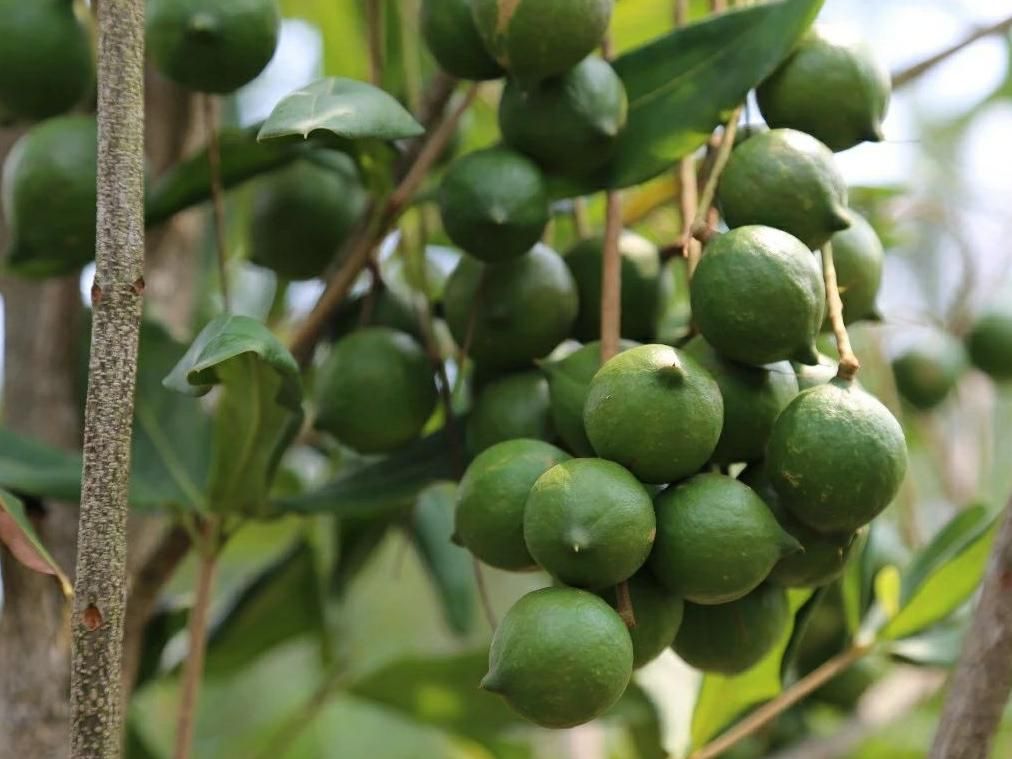
Macadamia (formally Macadamia, commonly called Australian macadamia) is an evergreen tree in the family Proteaceae. Its spherical drupes have a leathery husk and a hard shell that encloses a creamy kernel that turns ivory to light brown at maturity. Renowned for its buttery aroma and crisp-tender texture, macadamia is celebrated as the “queen of dried fruits” and the “king of nuts.”
Origin & Spread
Origin. Native to the border region of southeast Queensland and New South Wales, Australia; first described in 1857. Local First Nations communities initially regarded the nuts as inedible before gradually adopting them as food.
Spread.
-
Global spread. Introduced to Hawai‘i in 1882, where abundant sunshine and rainfall favored rapid expansion. Commercial cultivation and varietal improvement took off after 1946, with successful large-scale production from 1956 onward.
-
Name. Although Australian in origin, the nut is widely known as “macadamia” and—because of early commercialization in Hawai‘i—colloquially as the “Hawaiian nut” in Chinese.
-
Into China. Trial introductions began in Yunnan in the late 20th century; Guangxi started testing elite cultivars in the early 1980s. Today, orchards are established in Yunnan, Guangdong, Guangxi and beyond.
Nutrition & Wellness
-
Heart-friendly fats. Fat content is among the highest of edible nuts, but ~80% are unsaturated—especially monounsaturated—beneficial for cardiovascular health.
-
Protein & amino acids. 15–20% high-quality protein containing 17 amino acids, including 10 essential ones.
-
Fiber & micronutrients. A good source of manganese and vitamin B1, with magnesium and dietary fiber.
-
Low-carb profile. Each nut contains ~4% sugars, making it a “low-carb nut” suitable for ketogenic diets.
Economic & Cultural Value
Economic value
-
High-value chain. Kernel is eaten directly or processed into premium pastries, chocolates, culinary oils and cosmetics; husk and shell also have uses.
-
Pricing trend. As domestic output grows, retail prices have become more accessible—online prices in 2025 are ~10% lower year-on-year, with quality product as low as ¥18.9 per jin—contrasting with the formerly high, import-driven era.
-
Global market. Demand exceeds 400,000 t annually, yet strict ecological requirements and long investment cycles long kept global output under 30,000 t, resulting in chronic undersupply.
Cultural value
Beyond snacking, macadamias feature in salads and hot dishes (e.g., macadamia with celery & lily bulbs), and enrich desserts such as cookies, cheesecakes, mousses and brownies—cementing their star status among nuts.
Macadamia Production in China at a Glance
-
Global standing. China’s in-shell output is projected to exceed 90,000 t in 2025, surpassing Australia and ranking China No. 2 worldwide.
-
Yunnan core region. Forecast 70,000 t in 2025. Lincang alone has 2.6277 million mu, nearly 40% of the world’s planted area—the largest single macadamia base globally.
-
Guangxi growth. Projected >20,000 t in-shell in 2025; Chongzuo reached 629,100 mu by 2024, the largest area in Guangxi.
Major Production Areas
|
Region |
Planted Area |
Output |
Industry Traits |
|
Lincang, Yunnan |
2.6277 million mu |
109,000 t (in-shell, annual) |
World’s largest single macadamia production base |
|
Yingjiang, Yunnan |
350,100 mu |
40,000 t (fresh fruit) |
No.1 in Dehong Prefecture, No.3 in Yunnan |
|
Chongzuo, Guangxi |
629,100 mu |
>45% of Guangxi total |
Largest planting area in Guangxi |
|
Yangchun, Guangdong |
5,000-mu demo base |
— |
Drives ~30,000 mu in surrounding areas |
Industry Traits & Challenges
Traits.
-
Tech-enabled. National institutes have assembled diverse germplasm and, via hybridization and radiation mutagenesis, selected stress-tolerant, high-quality cultivars.
-
Policy support. Many regions advance organized production through “government guidance + enterprise leadership + financial tools + technical services.”
-
Long cycle. Typically 5–6 years from planting to bearing; upfront investment is substantial.
Challenges.
-
Broad pest & disease pressure. >30 diseases (10+ of major concern) and >300 insect pests have been recorded.
-
Conventional control limits. Manual spraying is slow and labor-intensive, timing is easy to miss, and skilled labor is scarce—leading to under-control and higher costs.
-
Direct losses if control fails. Yield reduction and quality downgrades (lower marketable rate) rapidly erode profitability.
Major Diseases and Pests
Key Diseases
1) Anthracnose
-
Symptoms. Small, pale-black lesions on leaves, tender shoots and fruits that expand; foliage and shoots yellow and die back; fruits blacken.
-
Epidemiology. Most common from May–August; intensified by rain, wind and fog.
-
Control essentials.
-
Cultural. Prune out infected shoots; promptly remove and destroy prunings.
-
Chemical. Apply registered fungicides such as carbendazim (e.g., 50% WP at label rate) or equivalent anthracnose-targeting products.
-
2) Blossom Blight
-
Symptoms/Epidemiology. Often triggered by prolonged cloudy-rainy weather: dark specks start on sepals, then entire flowers and inflorescences brown; peduncles darken and flowers abscise.
-
Control essentials.
-
Cultural. Avoid excessive density; light pruning before bloom to improve airflow.
-
Chemical. During full bloom, spray a labeled fungicide (e.g., 50% carbendazim at ~1:800 dilution) per local guidance.
-
3) Rapid Decline
-
Symptoms. Usually in mature orchards; stems/branches or roots affected. Leaves on an infected tree turn quickly yellow, then reddish-brown but remain attached; trees can die within 15–30 days, with faster progression in rainy weather.
-
Control essentials.
-
Cultural. Strengthen water–nutrient management; reduce injuries; enhance vigor.
-
Physical. Remove dead trees promptly; disinfect and solarize soil; replant with care.
-
Key Pests
1) Defoliators (leaf-feeders) — thrips, Hypomeces weevils, bagworms, Euproctis spp., etc.
-
Damage. Feed on young foliage; severe cases leave shoots bare, sharply reducing photosynthetic area and growth, thus lowering yield.
-
Control essentials.
-
Physical. Remove infested leaves; hand-pick Coleoptera leveraging thanatosis.
-
Chemical. Early infestations (often spring): apply labeled broad-spectrum insecticides, e.g., 40% dimethoate 500–800× or 80% trichlorfon 1000×, repeating ~every 15 days as needed.
-
2) Fruit borers & fruit pests — thrips, Coniogyra spp. (litchi leaf-roller), Carposina sasakii group (peach fruit moth), Deudorix epijarbas (Hainan subspecies), Leptoglossus spp., etc.
-
Damage. Yellowing husk, boring holes, internal necrosis; direct yield loss.
-
Control essentials.
-
Cultural. Remove infested fruits; collect and destroy fallen nuts to reduce larval carryover.
-
Biocontrol. Use sex-pheromone lures and sticky cards (e.g., for peach borer moth) to suppress adult populations.
-
3) Trunk/branch borers — chiefly cossid moths and leafhoppers (oviposition injury).
-
Damage. Cossid larvae bore from leaf axils upward, killing seedlings; leafhopper oviposition causes twig dieback.
-
Control essentials.
-
Physical/Chemical. Inject 40% dimethoate 800–1000× solution into borer holes for cossids.
-
Cultural. Prune and remove twigs bearing leafhopper eggs to curb hatch.
-
Recommended Operation Parameters
|
Target pest/disease |
Application rate |
Droplet size |
Flight height |
Flight speed |
Route spacing |
|
Blossom Blight |
8–12 L/mu (≈ 120–180 L/ha; ≈ 48–72 L/acre) |
≈ 40 µm |
≈ 3.5–4.5 m above canopy |
2.7–4.0 m/s |
≈ 3.5–4.5 m |
The parameters above are for reference only. Please adjust the operation settings to the actual crop growth stage, field conditions, and equipment model.
These parameters are derived from trials in major macadamia-growing regions. Pest and disease incidence varies by region and season—select and apply pesticides as required.
Why J100 for Macadamia — Precision Coverage, Real Efficiency
Across Yunnan’s rolling macadamia belts, the J100 delivers precise spraying and high-efficiency operations. By targeting major diseases (e.g., anthracnose, canker) and key pests (e.g., thrips, cossid borers) on time and on target, while penetrating tall, dense canopies, J100 achieves truly three-dimensional coverage. This closes “blind spots” left by ground sprayers, cuts input use, protects kernel quality and yield, and helps growers reduce costs and boost returns.