Overview
Oil palm (Elaeis guineensis) is an evergreen palm famed as the “king of oils” for its exceptional oil yield. Trees reach ~10 m tall with ~50 cm stems and 3–4.5 m pinnate fronds whose spines hide clusters of egg-sized, yellow-to-red fruits. A single tree can produce 30–40 kg oil/year; per-mu output commonly reaches 100–200 kg, and with elite cultivars small plots may exceed 600 kg/mu. In Malaysia, top estates achieve ~5 t oil/ha, far surpassing peanuts (×5) and soybean (×9) on the same area.
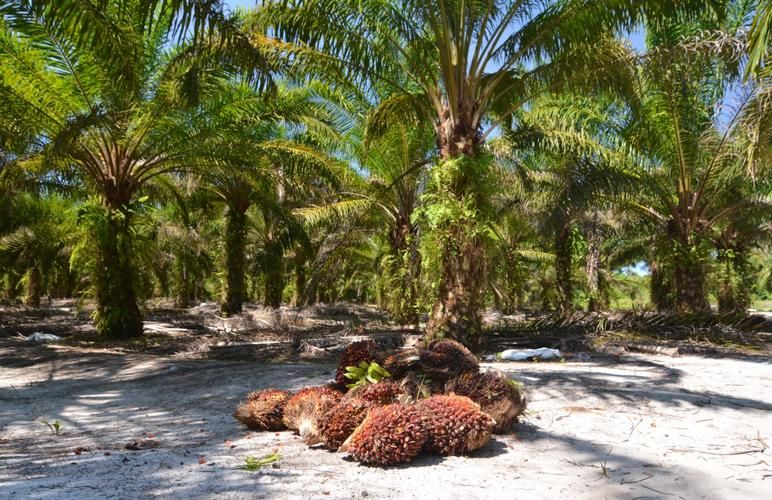
Origin & Spread
Origin. Native to tropical West Africa; archaeological evidence shows palm fruit, kernels, and oil were dietary staples ~5,000 years ago.
Globalization. Known in Europe by the 15th century; demand surged in the Industrial Revolution (candles, lubricants). 1848: Dutch colonials introduced oil palm to Java; 1910: British planters established estates in Malaya.
China. First introduced in 1926; today cultivated across Hainan, Guangdong, Guangxi, Yunnan, Fujian, Taiwan, and other warm, humid zones.
Nutrition & Wellness
-
Oil characteristics. Fruit mesocarp oil content >50%; crude palm oil is reddish, non-drying, rich in carotenoids, vitamin E (tocopherols/tocotrienols), with trace cholesterol.
-
Fatty components. Contains diverse fatty-acid amides (alkylamides); stable frying performance and long shelf life for products like chips and instant noodles.
-
Nutrition. Carotenoids confer antioxidant capacity; refined palm oil is clear and neutral, suitable for food and certain medicinal uses.
Economic & Cultural Value
Economic Value
-
Full-chain value. From food processing (frying oils, confectionery) and personal care (emollients, surfactants) to biodiesel and health ingredients, oil palm supports a broad industrial ecosystem.
-
Circular utilization. Press cake, shells, and empty fruit bunches (EFB) fuel biomass power and yield bioactives; fronds and trunks (lignocellulose) become green panel/furniture feedstock—targeting “1 t oil → 9 t resource use” with near-zero waste.
-
Product slate. Palm oil (mesocarp) and palm kernel oil (endosperm) refine into premium shortenings, cocoa-butter replacers, ice-cream fats, and fine soaps; shells can be processed to acetic acid, methanol, activated carbon, and fiberboard; press cake is feed; inflorescence sap can be fermented.
Cultural Value
-
In West Africa, palm oil has long served cuisine, soap making, lighting fuel, and even building material—its distribution often maps historic settlements.
Oil Palm in China at a Glance
-
Scale & Output
Nationwide area and output vary year to year (refer to the latest statistical yearbooks). China is actively piloting scaled planting along the northern tropical fringe (≈18–25°N) under coordinated programs led by CATAS with government, research, and industry partners. -
Key Regions
Hainan, Yunnan, Guangdong, Guangxi and other warm southern provinces host most plantings; Hainan is among the earliest and remains a core production zone. -
Industry Traits & Challenges
Traits —-
Tech enablement: 426 germplasm accessions collected; five cold-tolerant, high-yield varieties selected; tissue-culture rapid propagation established.
-
Integrated chain: From land preparation, fertigation, assisted pollination, harvesting, and IPM to understory farming packages.
-
Policy model: “Government guidance + enterprise leadership + finance + science” driving organized production.
Challenges — -
Pest/disease diversity: ~35 recorded diseases (≥10 major); typical disease losses >10% annually.
-
Manual limits: Low efficiency, difficult timing, and high labor costs in tall canopies across large estates.
-
Direct losses: Poor control reduces bunch number and oil extraction rate, downgrades fruit quality, and compresses margins.
-
Major Diseases & Pests
Key Diseases
Fusarium wilt (wilt disease)
-
Damage: Most destructive disease; 10–40% stand loss. Seedlings stunt; outer fronds scorch; stem vascular tissue browns (brown/pink/black). In 3–15-year palms, emerging leaves shorten, crown flattens, outer fronds dry.
-
Control essentials: Plant tolerant/resistant cultivars; balanced nutrition (emphasize K); proper irrigation; rogue heavily infected trees; drench benomyl for light infections per label.
Basal stem rot
-
Damage: Lethal on >10-year palms; estate losses up to 80%. Basal tissues rot; fungal fructifications appear; fronds break at the base and droop cloak-like.
-
Control essentials: Pre-plant stump removal and thorough site sanitation are primary measures.
Nursery damping-off / seedling blight
-
Damage: High seedling mortality; survivors are stunted and unfit for transplant. Roots show cortex rot, leaving a hollow sheath and stele with dark sclerotia.
-
Control essentials: Black PE bags for nursery; maintain uniform moisture; shade in dry seasons to reduce soil temperature; drench benomyl + thiram as labeled.
Key Insect
Red palm weevil / palm weevil (oil palm weevil)
-
Damage: Larvae bore stems, weakening palms and causing collapse/death when severe.
-
Control essentials: Routine scouting, early removal/sanitation; targeted insecticides and biotech lures where available; conserve natural enemies.
Integrated IPM Principles
Prioritize prevention and integration: resistant varieties, nutrition and pruning, timely harvest, winter sanitation; physical tools (light traps, pheromone traps); biologicals and natural enemies; and judicious chemistry—high-efficiency, low-tox, low-residue actives per safety standards.
Recommended Operation Parameters
|
Target pest/disease |
Application rate |
Droplet size |
Flight height |
Flight speed |
Route spacing |
Oil Palm Weevil |
6–12 L/mu (≈ 90–180 L/ha; ≈ 36–73 L/acre) |
≈ 40 μm |
≈ 3.5–5 m above canopy |
3–5 m/s |
≈ 4–5 m |
The parameters above are for reference only. Please adjust the operation settings to the actual crop growth stage, field conditions, and equipment model.
These parameters are derived from trials in major oil-palm–growing regions. Pest and disease incidence varies by region and season—select and apply pesticides as required.
Why J100 for Oil Palm — Penetration, Throughput, and Yield Protection
Across Malaysia’s vast estates, the EAVISION J100 precision agriculture drone tackles the global challenge of tall-crop protection. High payload and endurance accelerate spray cycles and lower cost per hectare, while powerful downwash drives droplets into lofty, spined crowns for uniform coverage—enabling precise control of palm weevil, Fusarium wilt, basal stem rot, and nursery diseases. By ensuring effective canopy deposition, the J100 helps estates stabilize bunch numbers and oil extraction rates, lifting management efficiency across tens of thousands of hectares and contributing a reliable “Chinese smart” solution to sustainable palm-oil production.