Overview
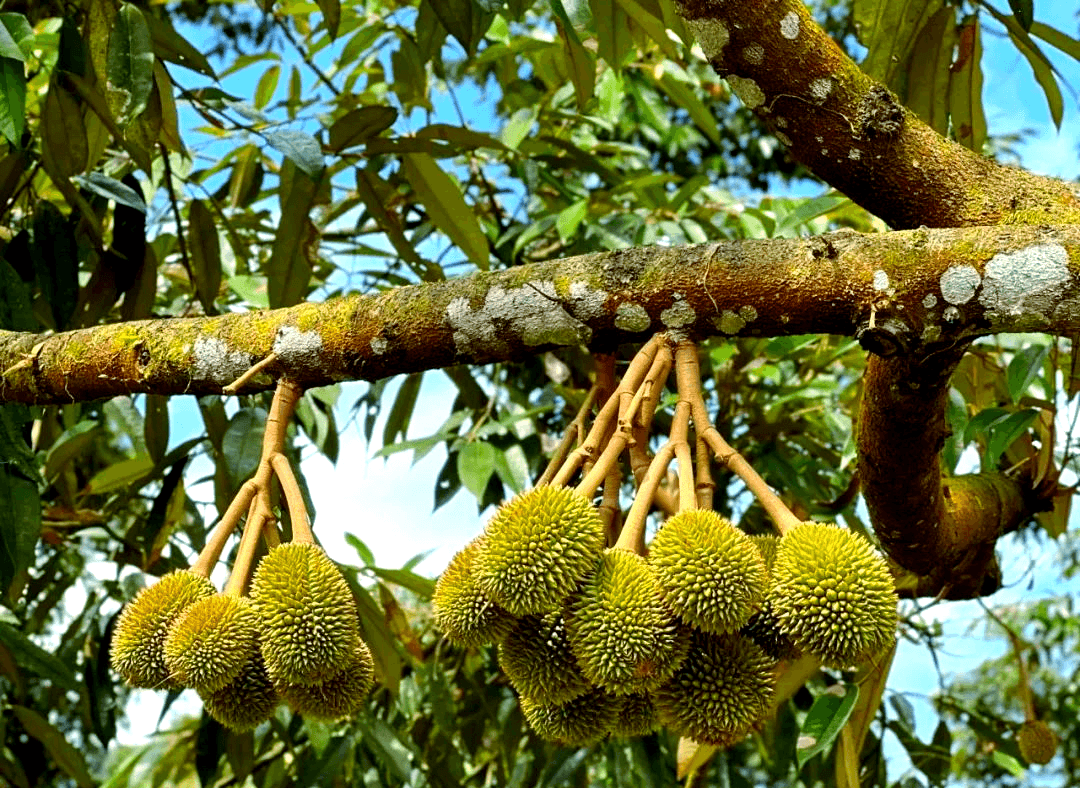
Durian (Durio zibethinus) is an evergreen tree in the mallow family (Malvaceae), genus Durio. Famed for its strong, pungent aroma and large, spiny fruit, it is celebrated across Southeast Asia as the “king of fruits.”
Trees reach 10–30 m; leaves are oblong with an acuminate tip. The fruit is a typical large capsule, football-sized and commonly 3–5 kg (some exceed 8 kg). A hard, spiny rind encloses fleshy arils that are pale yellow, sticky-juicy, and intensely flavored.
Origin & Spread
Origin. Native to Southeast Asia—especially Indonesia and Malaysia, including Sumatra and Kalimantan (Borneo). As a primary rainforest species, durian was foraged and eaten long before written records.
Global Spread
From the native range, durian spread across Thailand, Viet Nam, Cambodia, Lao PDR, Myanmar, and the Philippines. The Malay word durian (“thing with spines,” from duri, spine) gave rise to the scientific name Durio and the English “durian.”
Into China
Chinese records begin in the Ming dynasty. Ma Huan’s The Overall Survey of the Ocean’s Shores notes a “strong-smelling fruit” called “du-er-yan,” describing its spiny rind and sweet flesh. A popular tale says Zheng He so prized the fruit that he named it “留恋” (to linger, to yearn), later phonetically rendered as “榴莲.”
Modern distribution
Durian is now grown across the tropics. Thailand is among the largest producers; Indonesia became the top producer in 2021. In China, planting occurs mainly in Guangdong, Hainan, and Taiwan.
Nutrition & Wellness
-
Vitamins. Rich in vitamin C, provitamin A (β-carotene), and B-complex vitamins. Vitamin C supports immunity and antioxidant defense; vitamin A helps protect vision and may help prevent night blindness.
-
Minerals. A good source of potassium and also contains calcium and zinc—important for physiological function and growth.
-
Fatty-acid profile. Predominantly unsaturated fatty acids (notably oleic and linoleic acids); both immature and mature fruit show relatively high unsaturated fractions.
-
Protein & amino acids. Contains protein and is rich in aspartic acid and glutamic acid, which support immune function and acid–base balance.
-
Phytochemicals. Flavonoids, polyphenols, and anthocyanins provide anti-inflammatory and antioxidant activity.
Usage notes. Despite its nutrient density (“one durian equals three chickens” is an exaggeration but hints at its energy load), durian is high-calorie and not easy to digest—avoid overconsumption. Sulfur-containing compounds may inhibit aldehyde dehydrogenase (ALDH); therefore, do not consume with alcohol.
Economic & Cultural Value
Economic Value
-
Global trade staple. Thailand is the world’s largest exporter; in 2021 exports reached 875,100 t.
-
China’s strong demand. China is the largest consumer market: fresh durian imports were 1.426 million t (2023) and 1.56 million t (2024), underpinning a vast value chain.
-
Deep processing. Beyond fresh fruit: durian chips, cakes, candies, ice cream, coffee, sticky rice desserts, sauces—and even savory dishes like durian chicken pot.
Cultural Value
Durian holds a special place in Overseas Chinese communities across Southeast Asia, featuring in literature and memoir. From street stalls to patisseries, it permeates local food culture; folk songs testify to its popularity.
Durian Production in China at a Glance
-
Area. Hainan currently has about 50,000 mu (~3,333 ha) under durian.
-
Output. Hainan produced ~300 t in 2024; output is expected to surge past 1,000 t in 2025.
Key Production Zones
|
Zone |
Growing Traits |
Main Cultivars |
Development Status |
|
Southern Hainan (Baoting, Sanya, Ledong, Lingshui) |
< 18° N; abundant heat & light |
Monthong, Musang King, Black Thorn, Kan Yao |
Core commercial belt with large, scaled orchards |
|
Northern Hainan (Wanning, Qionghai) |
≥ 18° N; technology-breakthrough area |
Cold-tolerant types such as Red Prawn |
Planting frontier expanding north; some areas already flowering/fruiting |
|
Guangdong, Taiwan |
Early introduction |
Diverse |
Small-scale trials |
Industry Traits & Challenges
Traits.
-
Science & technology. Research institutes (e.g., CATAS) have assembled >60 elite germplasm lines; hybrid breeding and radiation mutagenesis are used to select high-quality, stress-resistant varieties.
-
Policy & finance. Seedling subsidies and loan-interest subsidies; banks have launched dedicated “durian loans.”
-
Long investment cycle. Trees typically need 5–6 years from planting to fruiting; upfront costs are 40,000–50,000 RMB per mu.
Core challenge — pest & disease control.
-
Complex epidemiology. Key problems include shoot/stem borers, leafhoppers, mealybugs, fruit borers, white root rot, and leaf rot, closely tied to weather and orchard micro-environment.
-
Limitations of ground spraying. Tall trees create spray shadows; conventional equipment struggles to reach inner and upper canopy.
-
Human capital gap. Rapid expansion outpaces the supply of skilled technicians (pollination, fruit set and retention, IPM).
-
Consequences. Unchecked fruit borers can damage >70% of fruit; mealybugs yellow leaves and can kill seedlings.
Major Diseases and Pests
Main Diseases
1) White Root Rot
-
Symptoms. Root surface covered by branching rhizomorphs forming a network; tips are white and flat, turning yellow to dark brown with age. Stele turns brown/white/pale yellow yet remains firm; in wet soil decayed roots become jam-like with a mushroom odor.
-
Control essentials.
-
Cultural. Avoid planting durian after old rubber trees where infected roots may remain.
-
Soil sanitation. Careful site prep and soil disinfestation before planting.
-
2) Leaf Rot
-
Symptoms. Leaf tissue scorches and drops prematurely.
-
Control essentials.
-
Site/Canopy. Plant in full-sun sites; disease is favored by shaded orchards.
-
Sanitation. Remove and destroy infected leaves promptly.
-
Main Insects
1) Mealybugs
-
Damage. Attack all stages; sap-sucking causes leaf yellowing and, in severe cases, death—especially on seedlings.
-
Control essentials.
-
Chemical. Mipcin 50% WP 15 g/10 L water; spray entire seedling. Apply weekly until eradicated (typically 2–4 applications).
-
2) Fruit Borer
-
Damage. Nocturnal moths lay eggs on flowers and young fruit; larvae tunnel into fruit. If not controlled, >70% losses can occur.
-
Control essentials.
-
Physical.
-
Light traps: install bulbs to exploit positive phototaxis.
-
Color traps: use yellow sticky boards or hang silver film.
-
-
Chemical. Doltox-503 15 mL/10 L water; thorough spray coverage.
-
Recommended Operation Parameters
|
Target pest/disease |
Application rate |
Droplet size |
Flight height |
Flight speed |
Route spacing |
|
Durian fruit borer |
8–12 L/mu (≈ 120–180 L/ha; ≈ 48–72 L/acre) |
≈ 40 µm |
≈ 3.5–5.0 m above canopy |
2.7–4.5 m/s |
≈ 4.0–5.0 m |
The parameters above are for reference only. Please adjust the operation settings to the actual crop growth stage, field conditions, and equipment model.
These parameters are derived from trials in major cherry-growing regions. Pest and disease incidence varies by region and season—select and apply pesticides as required.
Why EAVISION J150 for Durian — Precision at Height
Across Thailand’s expansive durian orchards, the J150 drone addresses the unique challenge of very tall canopies. Long endurance and high payload enable efficient coverage of large blocks; a powerful down-wash drives droplets deep through dense foliage to the inner and upper canopy, delivering accurate control of fruit rot/borers and other key pests. Precision application improves fruit appearance and quality while raising orchard management efficiency.