Overview
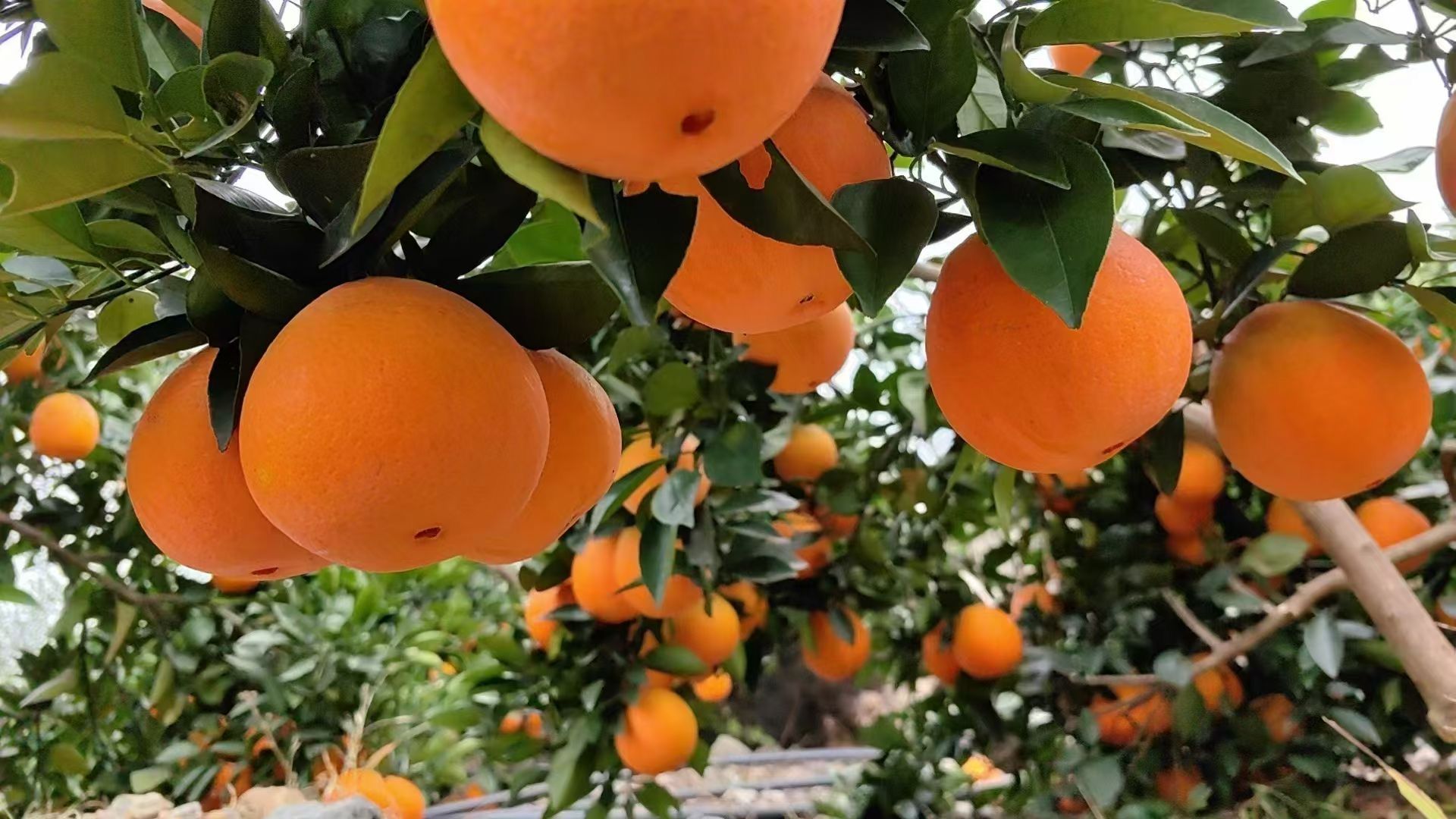
Navel orange (Citrus sinensis) is an evergreen small tree in the genus Citrus (Rutaceae). The “navel” at the stylar end gives the fruit its name. Flesh ranges from orange-yellow to deep orange, crisp and juicy with a strong aroma—excellent for both fresh consumption and processing. Trees reach 5–8 m; leaves are leathery; flowering occurs from March–May; harvest is October–December (late cultivars can extend to February–April the following year). Globally popular, navel orange carries dietary, economic, and ecological value.
Origin & Spread
-
Origin. Navel orange arose as a bud mutation of Chinese sweet orange. China has >4,000 years of citrus cultivation. Sweet orange reached Europe before the 14th century via Portuguese traders and was later introduced to Brazil.
-
Key milestones.
-
1870: A seeded sweet orange ‘Selecta’ in Brazil bud-mutated to a seedless navel; after introduction to the U.S., it became ‘Washington Navel’.
-
1878: Commercial success in California; ‘Washington Navel’ became a leading cultivar worldwide.
-
-
Introduction to China. Multiple waves in the early 20th century (e.g., 1919 to Zhejiang; 1928 to Guangzhou). From the 1960s–1990s, Chinese institutes introduced elite lines from Morocco, the U.S., etc., fostering regional brands such as Fengjie Navel Orange and Gannan Navel Orange.
Nutrition & Wellness
-
Vitamins: Vitamin C (≈33–75 mg/100 g), carotene (≈160 µg), B-vitamins.
-
Minerals: Potassium (≈159 mg), calcium (≈20 mg), magnesium (≈14 mg) per 100 g edible portion.
-
Bioactives: Flavonoids, limonoids (e.g., limonin), pectin.
-
Potential benefits: Support healthy cholesterol and cardiovascular function; antioxidant activity; in TCM, navel oranges are said to quench thirst and aid digestion.
Economic & Cultural Value
-
Industry scale. Gannan navel oranges reach ≈¥12 billion in annual output; Zigui’s full value chain approaches ≈¥20 billion.
-
Exports. Gannan navel oranges were first exported to Hong Kong in 1977 at HK$36/kg.
-
Cultural heritage. From Qu Yuan’s Ode to the Orange (Zigui) to Su Shi’s verse “a recluse planting a thousand orange trees,” citrus figures prominently in Chinese letters.
-
Branding. Fengjie promotes ecological orcharding (“windows in trees, grassed alleys”); Gannan builds a philanthropic “Caring Orange” brand story.
Navel Orange Production in China
-
Planting area & output. Cultivation spans 12 provinces/municipalities. Zigui County alone has ≈400,000 mu with >1 million tons of capacity. Gannan dominates Jiangxi; Fengjie’s base covers ≈150,000 mu.
Key Production Areas
|
Region |
Signature Cultivars |
Industry Scale / Notes |
|
Fengjie, Chongqing |
Fengjie Navel, Late-maturing Navel |
≈20% of local agricultural output; “one tree supports 300,000 people.” |
|
Ganzhou, Jiangxi |
Gannan Navel |
≈¥12 billion annual output; export hub. |
|
Zigui, Hubei |
‘Robertson 35’ navel |
Nearly ¥20 billion across the full value chain. |
|
Shaoyang, Hunan |
‘Yuanfeng’ navel |
Selected as a national elite-cultivar demonstration base. |
Industry Traits & Challenges
Traits
-
Science & tech enablement. Germplasm innovation (e.g., Taizhou/Huangyan introduced 102 accessions) lifts quality.
-
Tertiary-industry integration. Gannan links farming, processing, branding, and agritourism.
Challenges
-
Disease & pest pressure. Huanglongbing and citrus canker can cut yields by >30% if unchecked.
-
Labor costs. Zigui’s porter workforce (“back-orange carriers”) averages 45–65 years old—costly and inefficient.
-
Hilly terrain. Steep orchards hinder mechanization; ground sprayers struggle to cover canopies.
Major Diseases and Pests
Citrus Canker
-
Symptoms. Volcano-like, corky raised lesions with yellow halos on leaves, shoots, fruit. As a quarantine disease, outbreaks are devastating for orchards and market access.
-
Host sensitivity. Navel orange is highly susceptible.
-
Control essentials. Copper fungicides (e.g., copper hydroxide, cuprous oxide, validamycin-copper) during flush expansion and early fruit set.
Anthracnose
-
Symptoms. Brown marginal leaf blight; fruit rot and drop.
-
Control essentials. Protective sprays at budbreak (e.g., mancozeb); remove infected shoots.
Spider Mites (Red/Yellow)
(e.g., citrus red mite, Panonychus citri; citrus yellow mite, Eotetranychus spp.)
-
Damage. Colonies feed on leaves, shoots, and peel causing silvery/gray stippling, defoliation, weakened trees, and downgraded fruit.
-
Control essentials. Conserve predatory mites; winter sanitation; apply selective acaricides at onset (e.g., abamectin, spirodiclofen) per label.
Recommended Operation Parameters
|
Target pest/disease |
Application rate |
Droplet size |
Flight height |
Flight speed |
Route spacing |
|
Red Spider Mite |
8–15 L/mu (≈ 120–225 L/ha; ≈ 48–90 L/acre) |
≈ 40 µm |
≈ 4.0–5.0 m above canopy |
2.5–4.0 m/s |
≈ 3.5–4.0 m |
The parameters above are for reference only. Please adjust the operation settings to the actual crop growth stage, field conditions, and equipment model.
These parameters are derived from drone application practices in Zigui County. Pest and disease incidence varies by region and season—select and apply pesticides as required.
Why J150 for Navel Orange — Precision That Pays
In Hunan’s hilly orchards, J150 drone’s terrain-following and AI obstacle avoidance handle complex topography with ease. Its finely controlled atomization and balanced downdraft deliver uniform coverage on both leaf surfaces and fruit, boosting efficacy while enabling careful dose control to help reduce residues. The result: cleaner peels, consistent internal quality, and stronger market competitiveness for Hunan navel oranges.