Overview
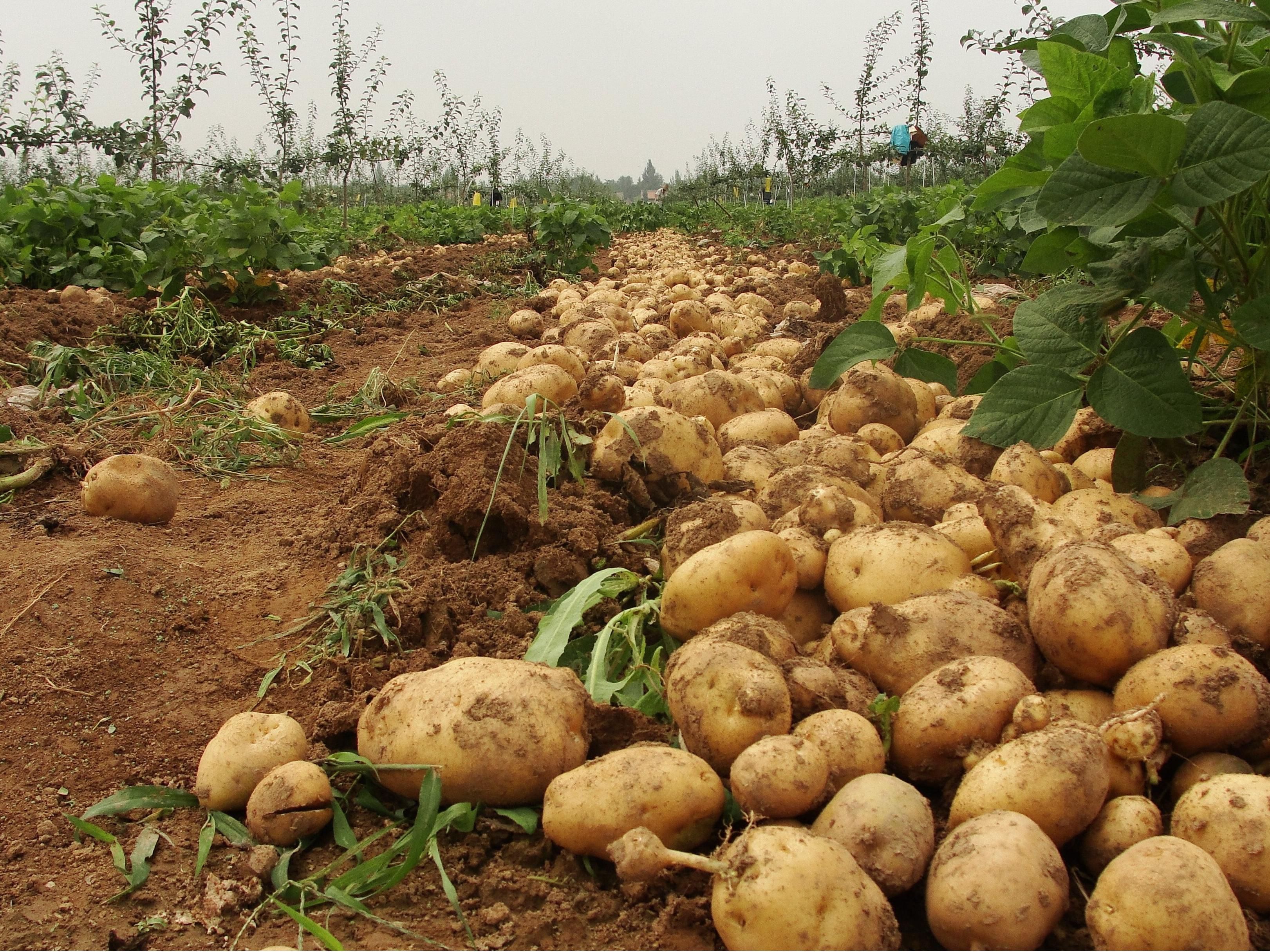
Potato (Solanum tuberosum) is an annual in the Solanaceae family and the world’s third-largest staple after wheat and maize. Plants stand ~50–80 cm tall and form underground tubers—the edible portion. Potatoes are renowned for drought/cold tolerance and performance on marginal soils; across China’s northwest drylands and rocky southwest hills where many crops struggle, potato remains the reliable “iron crop.”
Origin & Spread
Origin
Native to the Andes; archaeological evidence indicates domestication around Lake Titicaca ~8,000 years ago.
Global spread
In the 16th century, Spaniards carried potatoes from Peru to Europe. Initially a botanical curiosity, potato soon became favored ship’s fare for long voyages and spread worldwide.
Into China
Generally believed to have arrived via the Maritime Silk Road in the late 16th–early 17th century.
Nutrition & Wellness
-
Vitamin-rich: Vitamin C levels exceed many apples.
-
Mineral-dense: Potassium content often surpasses bananas.
-
Protein quality: Potato protein has high nutritional value with low allergenicity, rising as a plant-protein favorite.
-
Dietary fiber: Supports gut health.
Economic & Cultural Value
Economic Value
-
Food security: As a top staple, potato is strategic for global and national security. In China, >70% of planted area lies in former poverty counties—where potato is both a key food and cash crop.
-
Income uplift: In Dingxi, Gansu, farmers call potato their “iron crop”; Huzhu, Qinghai reports potato-sector income >RMB 105 million.
-
Full-chain development: In Ulanqab, Inner Mongolia, output spans starch, whole powder, prepared foods, with by-products fully utilized: potato protein for the plant-protein market; pomace to fiber supplements or feed—extracting maximum value.
Cultural Value
-
Cultural heritage & branding: FAO’s GIAHS recognizes potato-linked systems (e.g., Chile’s Chiloé, Peru’s Andes, Tunisia’s Ghar Melh, Portugal’s Barroso). Domestically, brands like Tengzhou Potato rank among China’s top regional ag brands (value RMB 13.621 billion).
Potato Production in China at a Glance
-
Scale & Output
-
Area: ~70 million mu in recent years.
-
Global standing: China ranks #1 in potato output.
-
Trend: Growth now relies more on yield gains than area expansion.
-
-
Key Regions (examples)
Region
Traits
Representative Area
Yield
North China
Double-cropping; multi-film cultivation
Tengzhou, Shandong
Up to >5,000 kg/mu
Northwest
Dryland; traditional heartland
Dingxi (Gansu), Huzhu (Qinghai)
Huzhu ~4,000 kg/mu
Southwest
Mixed systems; multi-harvest
Yunnan, Guizhou
High autumn yields
Northeast
Single-season; scale operations
Ulanqab, Inner Mongolia
“China’s Potato Capital” (area & output lead)
-
Industry Traits & Challenges
Traits —-
Tech enablement: Composite tillage (e.g., 40 cm subsoiling + 20 cm rotary in one pass) breaks hardpans and cuts tillage time by ~50%, raising plant height +4.0–22.3%, single-tuber weight +4.0–10.7%, and large-tuber counts +6.3–18.5%.
-
Demonstrated impact: Core demos (e.g., Dingxi) scaled from 230 mu nucleus to >1,150 mu co-op demos, radiating ~28,000 mu across 7 townships in three years.
-
Market timing: Shandong supplies in Apr–Jun, the national off-season—low supply, strong prices.
Challenges — -
Complex pest/disease spectrum: Late blight, early blight, viruses, common scab, blackleg, ring rot, black scurf, bacterial wilt; plus aphids, 28-spotted ladybird, L. decemlineata relatives / flea beetles, wireworms, grubs, cutworms, potato tuber moth, etc.
-
Residues & environment: Risk of MRL breaches and packaging waste if misused.
-
High control cost & resistance: Repeated single-chemistry use drives resistance and outbreak risk.
-
Major Diseases & Pests
Key Diseases
Late blight (Phytophthora infestans)
-
Damage: Most destructive disease of potato; attacks leaves, stems, tubers. Leaf lesions start water-soaked at tips/margins → enlarge into dark-green, diffuse patches.
-
Control essentials: Resistant varieties; forecasting/early warning; rogue and deeply bury centers; treat at first sign with targeted fungicides per label.
Early blight
-
Damage: Mainly leaves, also tubers. Dark brown circular lesions with concentric rings.
-
Control essentials: Region-suited resistant/tolerant varieties; 3+ year rotations with non-solanaceous crops; strengthen facility, water, and nutrition management to maintain vigor.
Virus diseases
-
Damage: Seed degeneration driver; leaf crinkling, mosaic, necrosis, dwarfing.
-
Control essentials: Virus-free seed; vector (aphid) control; plant virus-resistant varieties.
Key Insect Pests
Aphids
-
Impact: Direct sap-sucking and primary virus vectors.
-
Control essentials: Integrate botanical/bio-insecticides as labeled; conserve predatory mites, parasitoids, lady beetles; enhance habitats for natural enemies.
Soil pests (grubs, wireworms, cutworms)
-
Impact: Tuber feeding → holes and downgrading.
-
Control essentials: Pre-plant soil treatments as labeled; rotations; integrate cultural controls.
Recommended Operation Parameters
|
Target pest/disease |
Application rate |
Droplet size |
Flight height |
Flight speed |
Route spacing |
Potato Late Blight |
3–8 L/mu (≈ 45–120 L/ha; ≈ 18–49 L/acre) |
≈ 40 μm |
≈ 3–5 m above canopy |
4–7 m/s |
≈ 4–5 m |
The parameters above are for reference only. Please adjust the operation settings to the actual crop growth stage, field conditions, and equipment model.
These parameters are derived from trials in major potato-growing regions. Pest and disease incidence varies by region and season—select and apply pesticides as required.
Why J150 for Potato — Stable Yields and Better Returns
In key production areas around Kunming, Yunnan, the EAVISION J150 drone underpins high and stable yields. Strong rotor downwash and a precision spray system deliver uniform, 3D deposition throughout the canopy—solving uneven coverage and missed timing common with manual/ground rigs. The J150 supports timely, targeted control of late blight, early blight, and key insect complexes such as aphids and soil pests, helping growers cut costs, raise efficiency, and protect the value of every potato from field to market.