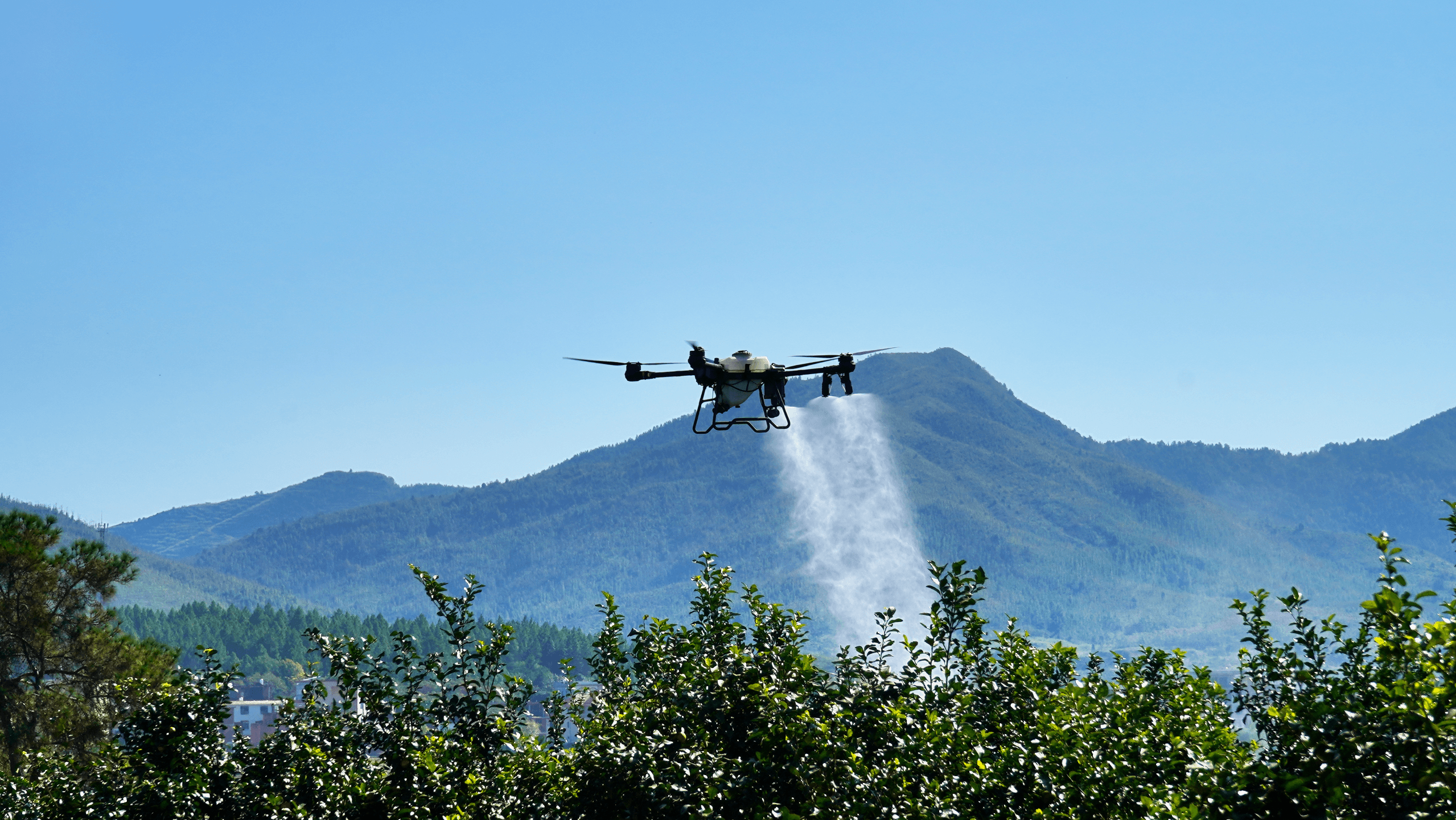
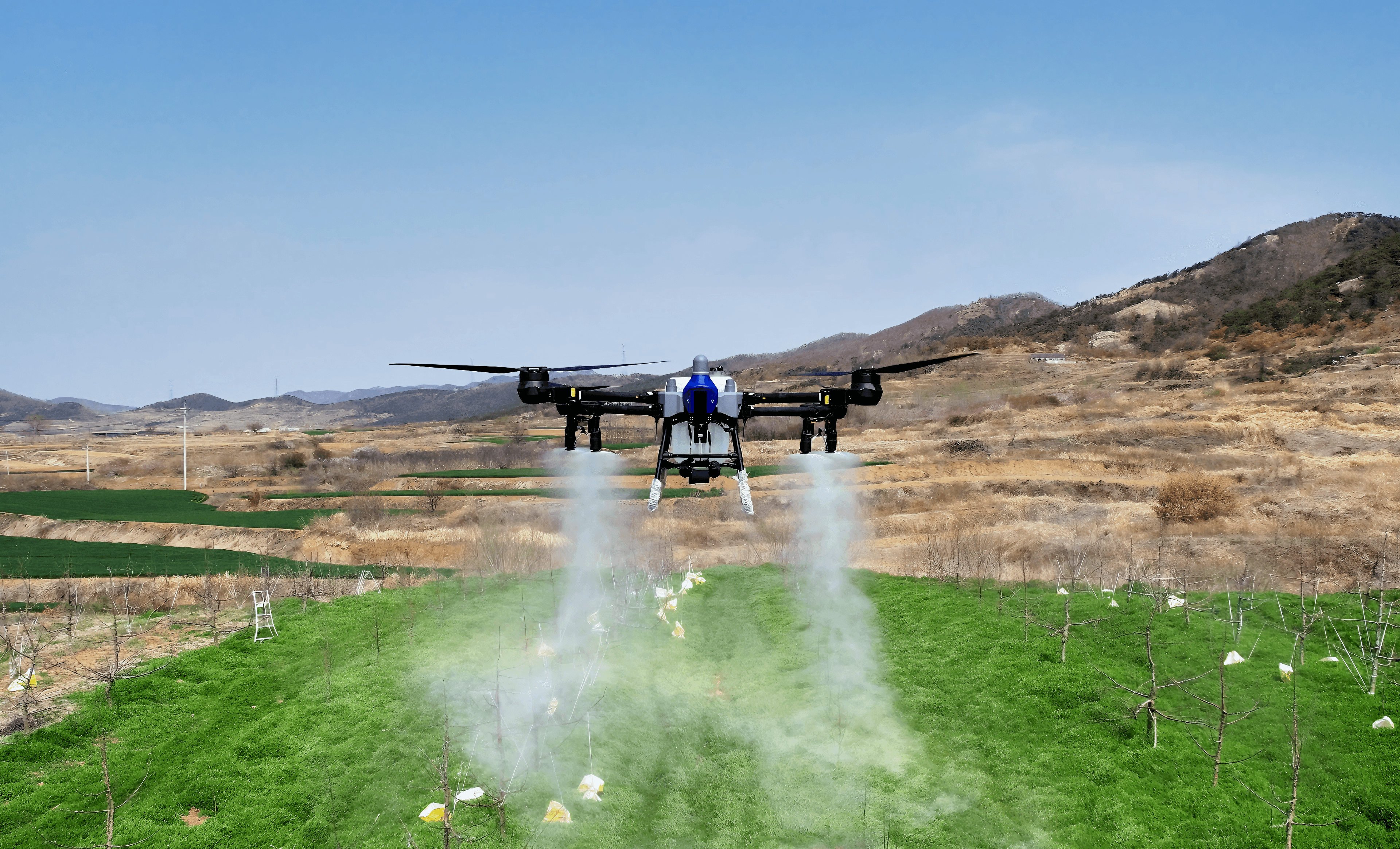
In modern agricultural operations, drone spraying has gradually become a widely used method for crop protection. Compared with traditional manual spraying or ground-based machinery, drones can complete large-area operations within a shorter time and maintain high efficiency even in complex terrain conditions. However, in practical applications, achieving uniform coverage within dense crop canopies remains a key challenge for drone spraying technology.
In orchards, tea plantations, or tall field crops, plants often form multi-layer canopy structures. During spraying, droplets tend to remain on the upper leaf surfaces, while the middle and lower layers are more difficult to reach. At the same time, terrain variations, airflow changes, and flight height can also influence the deposition path of droplets. Therefore, improving droplet penetration and distribution within crop canopies—while maintaining spraying efficiency—has become a critical issue in the design of agricultural drone spraying systems.
To address this challenge, the EAVISION J150 adopts an ambient-temperature mist spraying system. Through the coordinated design of nozzle structure, droplet control, and airflow utilization, the system is able to maintain stable spraying performance under different crop structures and operating environments.
Droplet Control: The Foundation of Spray Performance
A spraying system must first provide stable and adjustable atomization capability. The EAVISION J150 is equipped with the 4th-Gen CCMS® Bimodal Mist Nozzle, supporting a droplet size adjustment range of 10–300 μm, allowing spraying parameters to be optimized according to crop type, canopy density, and operating conditions.
Powered by a 2000W FOC ESC, the system can continuously generate droplets smaller than 40 μm even at a flow rate of 40 L/min, maintaining efficient spraying performance while ensuring high-quality atomization. The four rear-mounted nozzle layout further improves system stability and durability, extending the overall lifespan of the nozzle system to approximately 30,000 liters of spraying volume.
Item
Specification
Rated Tank Capacity
70 L
Full-Load Capacity
73 L
Nozzle Model
EAV-CCMS60
Number of Nozzles
2 or 4
Droplet Size Range
10–300 μm
Pump Type
Impeller Pump
Pump Quantity
2
Maximum Flow Rate
40 L/min (±5%)
Airflow Utilization: Enhancing Canopy Penetration
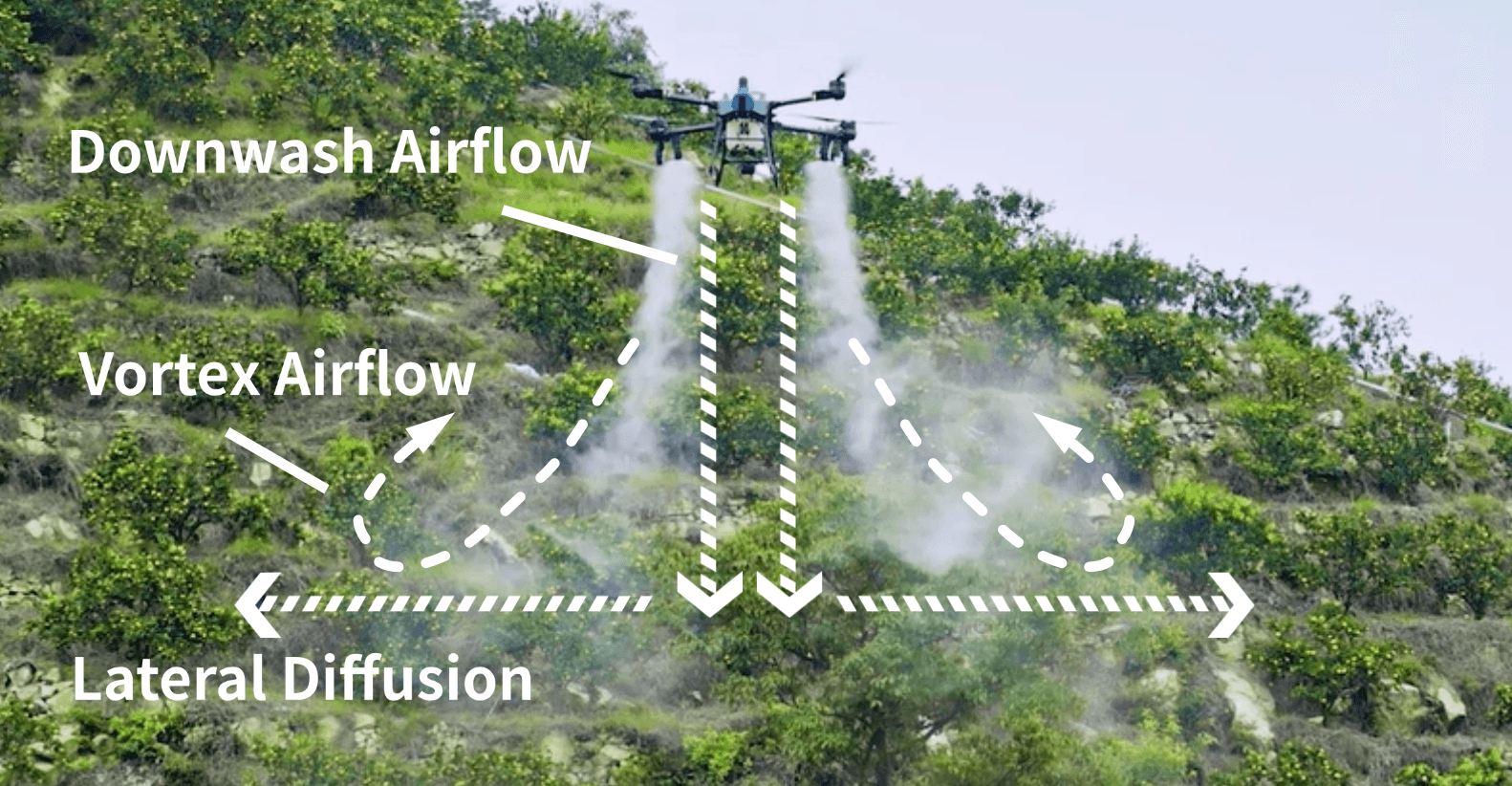
During drone spraying operations, airflow structure also plays a crucial role in determining spray performance. The spraying system of the EAVISION J150 utilizes the downward rotor wash generated by the propellers, combined with an optimized rear airflow design, to create a stable airflow pattern during operation.
This airflow carries droplets deeper into the crop canopy and distributes them more evenly among plants. Compared with relying solely on atomization, airflow assistance can significantly improve coverage in the middle and lower layers of crop foliage.
At the same time, the Hybrid Droplet Technology of the EAVISION J150 supports multiple droplet size combinations during spraying. Larger droplets provide uniform coverage on leaf surfaces, while smaller droplets can travel deeper into the crop canopy with the airflow. The interaction between droplets of different sizes and the rotor-generated airflow forms a multi-directional, multi-layer spraying structure, enhancing overall canopy coverage.
Through the coordinated interaction of airflow dynamics, droplet control, and nozzle structure, the EAVISION J150 can maintain stable and reliable spraying performance even in complex agricultural environments.
Operational efficiency is one of the most notable advantages of drone spraying. Traditional manual backpack spraying requires farmers to carry tanks and walk through fields during operation, resulting in relatively low efficiency. In field conditions, a skilled worker can typically spray only about 1 hectare (approximately 2.5 acres) per day. In contrast, drones can follow pre-planned flight routes and operate continuously, significantly reducing walking time and avoiding repeated spraying.
Taking the EAVISION J150 as an example, under typical field crop conditions, a single drone can usually complete around 70–100 hectares (approximately 170–250 acres) of spraying per day. Compared with traditional manual spraying, this represents an efficiency improvement of dozens of times. Such efficiency allows farmers to respond quickly during pest outbreaks or within limited weather windows, improving the timeliness of crop protection operations.
In orchard environments and other complex crop structures, however, drone efficiency is typically lower than in open fields. Because spraying must often be performed around individual trees to ensure effective coverage, the drone may need to hover or fly more slowly. Industry data show that in orchard environments, drones typically complete about 10 hectares (approximately 25 acres) per day, which still represents a significant improvement compared with manual spraying.
With features such as automated flight planning, precise spraying control, and stable flight performance, the EAVISION J150 is able to maintain high operational efficiency across different agricultural scenarios while significantly reducing labor requirements.
Resource Efficiency: Reducing Water and Chemical Use
As agriculture becomes increasingly large-scale, resource efficiency has become an important consideration alongside operational speed. Drone spraying typically uses low-volume application methods, which can significantly reduce water consumption while maintaining effective crop protection.
Compared with traditional high-volume manual spraying, drone spraying can reduce water usage by approximately 80–90%. At the same time, more precise droplet control and improved deposition efficiency help minimize unnecessary chemical loss. Under certain crop and operating conditions, pesticide use can also be reduced by approximately 30–40%compared with conventional manual spraying.
For many agricultural regions, improving pesticide utilization and reducing water consumption can help lower production costs while also reducing the environmental impact of agricultural operations.
The Continuing Evolution of Agricultural Spraying Technology
With the development of smart agriculture, drone spraying systems continue to evolve. From atomization technologies and airflow utilization to intelligent flight control, the integration of these technologies is steadily improving operational efficiency and expanding the possibilities for different agricultural scenarios.
If you would like to learn more about how the EAVISION J150 platform performs in real-world agricultural spraying operations, please click “Contact Us” below to connect with our team.