In agricultural production, the spreading of fertilizer or granular materials may seem like a simple task, yet it plays a crucial role in crop management. The efficiency and uniformity of spreading directly influence crop growth and overall input costs. However, in many farms, spreading operations still rely on manual broadcasting or traditional ground machinery. While these methods have been used for decades, they often lead to familiar challenges such as uneven distribution, overlapping coverage, and high labor demand.
As farm sizes continue to grow, these issues become increasingly noticeable. As a result, improving operational efficiency while maintaining uniform fertilizer application has become an important objective in modern agricultural management.
Aerial spreading introduces a new way of working
With the advancement of precision agriculture technologies, drones are becoming an increasingly important tool in farm operations. By operating from the air, fertilizer or granular materials can be distributed across fields quickly, reducing reliance on ground equipment and manual labor.
The EAVISION J150, equipped with the SPD100 Spreading System, combines aerial mobility with a stable material delivery mechanism, enabling operators to cover larger areas in a shorter period of time.
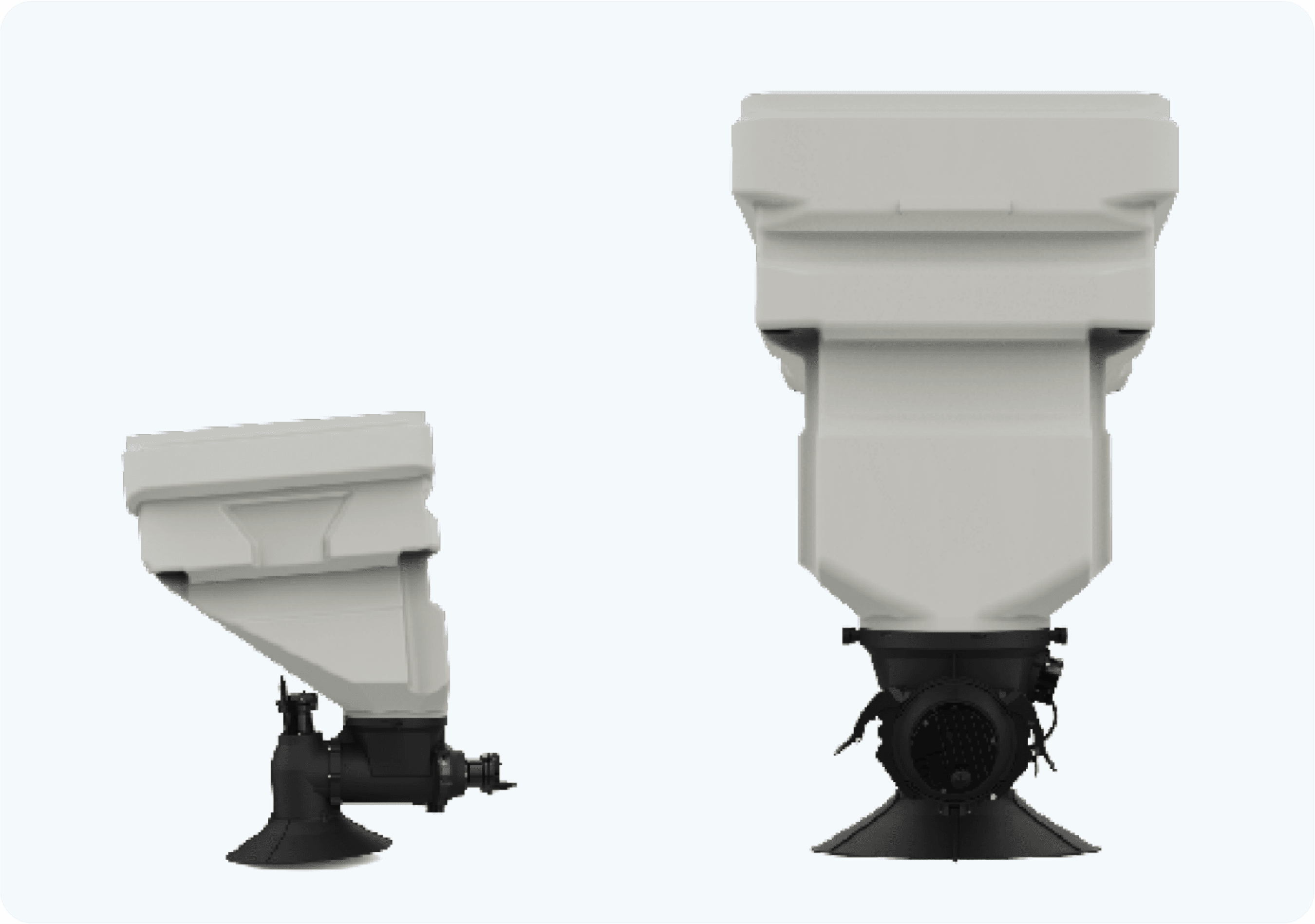
The system features a 100-liter hopper, and uses a Screw Feeder Assembly to deliver granular materials steadily to a centrifugal spinner disc. As the disc rotates at high speed, the materials are evenly distributed across the working area.
Why spreading efficiency matters in field operations
Weather conditions and timing are critical factors in agricultural production. In many cases, spreading operations must be completed within a limited time window—for example before planting or during key crop growth stages.
If spreading efficiency is insufficient, several challenges can arise:
The SPD100 spreading system mounted on the J150 platform is designed to maintain continuous and stable material delivery. In real-world operations, the system can achieve a maximum spreading rate of up to 240 kg/min with a working width of 3–8 meters.
This allows the drone to complete fertilizer applications across large areas in a much shorter time, significantly improving overall field operation efficiency.
How the spreading system achieves stable and uniform distribution
In an aerial spreading system, material delivery and distribution must work together seamlessly.
The J150 spreading system adopts a screw-feeding and centrifugal-spreading structure. The screw feeder transports granular materials from the hopper to the spreading mechanism, while the high-speed centrifugal disc distributes the materials evenly across the field.
This design helps maintain a stable material flow under different operating speeds, reducing gaps and overlaps during application.
Different materials require different screw feeder assemblies
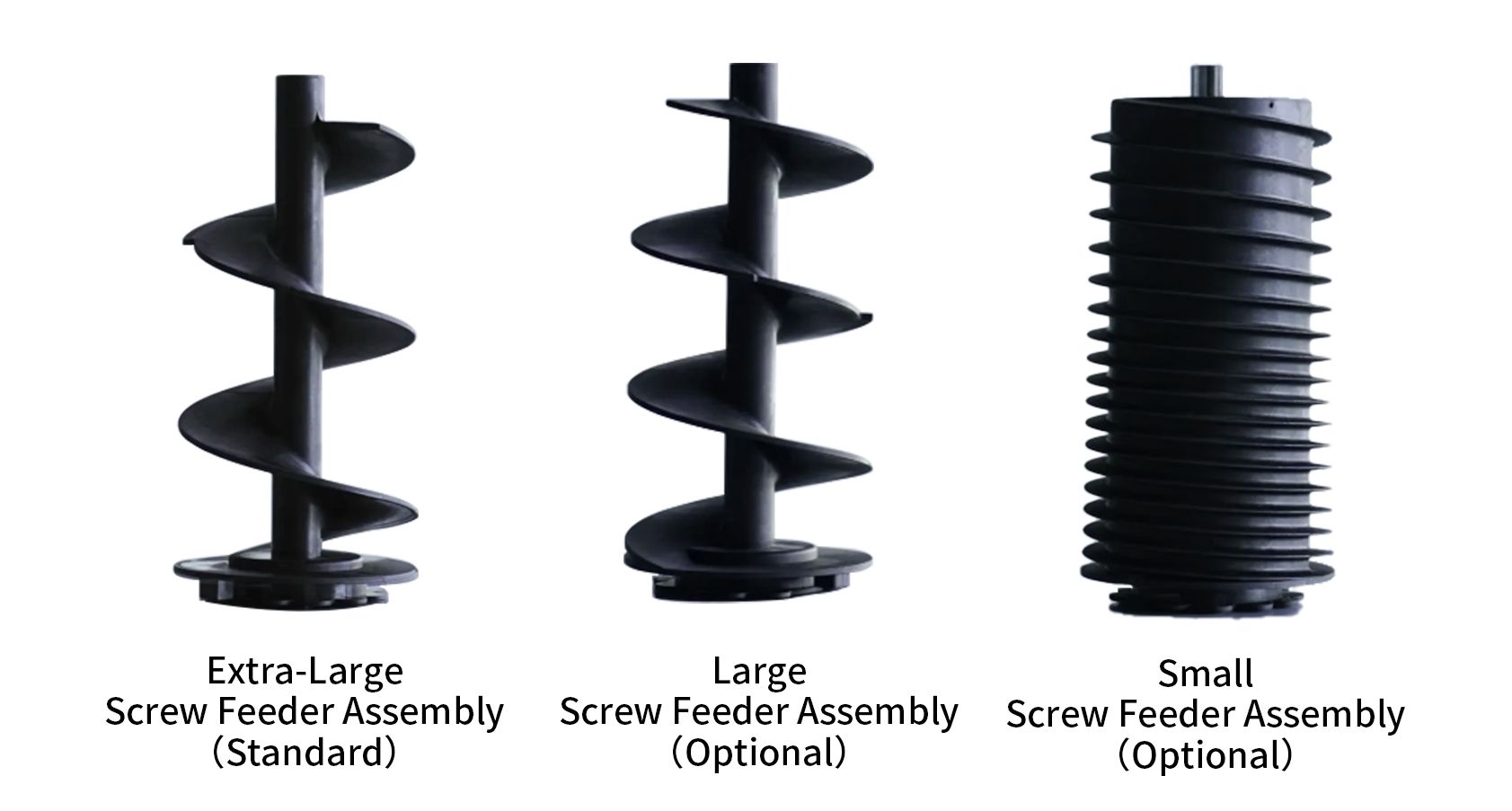
In real agricultural operations, granular materials can vary significantly in size and density. Fertilizer granules, grain seeds, and aquaculture feed pellets all behave differently during spreading.
To accommodate these differences, the J150 spreading system offers three screw feeder assembly configurations, allowing the system to adapt to a wide range of agricultural applications.
|
Auger Type
|
Applicable Particle Size
|
Typical Materials
|
|
Extra-Large Screw Feeder Assembly(Standard)
|
0.5–10 mm
|
fertilizer, wheat, animal feed, etc.
|
|
Large Screw Feeder Assembly (Optional)
|
4–10 mm
|
fertilizer, wheat, animal feed, rice, etc.
|
|
Small Screw Feeder Assembly (Optional)
|
0.5–4 mm
|
pelleted aquafeed, rice, rapeseed/canola seed, granular herbicides
|
By using different screw feeder assemblies, the spreading system can be configured to match specific operational needs, allowing it to handle a wide range of agricultural materials and field conditions.
Key specifications of the SPD100 Spreading System are shown below.
|
Specification
|
Details
|
|
Model
|
EAV-SPD100
|
|
Hopper Capacity
|
100 L
|
|
Spreading Width
|
3–8 m
|
|
Maximum Spreading Flow Rate
|
240 kg/min
|
|
Suitable Particle Size
|
1–10 mm
|
|
Application Rate
|
0.2–50 kg/mu
|
|
Application Accuracy
|
≤5% (dry material); ≤10% (wet material)
|
|
Material Flow Detection
|
≤500 ms response time
|
|
System Weight (including hopper)
|
≤5 kg
|
|
Spreading Mechanism
|
Involute centrifugal spinner disc + screw feeder
|
Enabling More Efficient Agricultural Spreading Operations
As agricultural production continues to move toward larger-scale and more intelligent farming practices, improving operational efficiency and resource utilization is becoming increasingly important.
By combining aerial mobility with a stable spreading system, the EAVISION J150 provides farmers with a more efficient approach to material distribution, reducing the need for labor-intensive manual spreading while helping operators cover larger areas more easily.
In modern agricultural environments, even routine tasks such as fertilizer spreading can significantly benefit from technological optimization, contributing to improved overall farm productivity.
If you would like to learn more about how the J150 platform performs in real-world agricultural spreading operations, please click “Contact Us” below to connect with our team.


