Agricultural Drone Battery Life: Charging Strategy for Full-Day Spraying


Agricultural drone battery life is one of the first questions buyers ask, but the answer is rarely just "how many minutes can it fly?" For spray operations, battery life is tied to tank size, payload, application volume, route length, refill time, charger speed, field power, heat, battery age, and crew discipline.
A spray drone does not work like a camera drone that flies once and returns to a case. A commercial agricultural drone may fly, land, refill, swap or charge batteries, reload a route, and repeat that cycle dozens of times in a day. The goal is not simply the longest single flight. The goal is keeping the operation moving without creating unsafe charging habits, unnecessary downtime, or battery wear.
This guide explains how to plan agricultural drone charging for full-day spraying. It covers battery specs, two-battery rotation, field power, high-temperature charging, and the buyer questions that matter before choosing a platform.
What Battery Life Really Means in Spray Operations
Agricultural drone battery life should be evaluated as part of the full spray cycle, not as flight minutes alone.
In agricultural spraying, battery life has three different meanings:
|
Battery Term |
What It Means |
Why It Matters |
|
Flight time |
How long the drone can fly under a given payload and condition |
Helps estimate route length and landing frequency |
|
Work cycle time |
Flight time plus landing, refill, battery swap, and route restart |
Determines whether the crew can keep the aircraft productive |
|
Charging cycle time |
Time needed to bring a battery back into the operating charge window |
Determines how many batteries and chargers the team needs |
Buyers often focus on flight time first. That is understandable, but flight time alone can be misleading. A drone with longer flight time but slow charging may still lose productivity across a full day. A drone with fast charging but poor refill workflow can also sit idle. The productive question is: can the whole system keep spraying?
For spray work, the agricultural drone battery should be evaluated with the entire job plan:
- Tank capacity
- Payload weight
- Application volume
- Flight speed
- Spray width
- Route shape
- Terrain and obstacles
- Battery charge time
- Refill time
- Battery cooling
- Crew size
- Power source
- Weather and temperature
That full-system view is what separates a paper specification from real daily output.
The Core Formula: Can Charging Keep Up With the Field Cycle?
A simple battery rotation model starts with one question:
If Battery A is charging while Battery B is flying, will Battery A be ready before Battery B lands again?
Use this planning formula:
Field cycle time = flight time + landing time + refill time + battery swap time + route restart time
Then compare:
If charge time is less than or equal to field cycle time, two-battery cycling may support continuous operation.
If charge time is greater than field cycle time, the team needs more batteries, more chargers, slower pacing, or a different workflow.
This is why charging strategy matters as much as battery capacity. The best field operation is not always the one with the largest battery count. It is the one where flight, refill, charging, cooling, and crew movement are balanced.
For example, if a drone has about 12 minutes of operating time in a typical spray condition and the charger can return a battery to the operating window in about 9 minutes, a two-battery rotation can be realistic when the crew also needs a few minutes for landing, refill, swap, and route restart. If field refill takes longer, the charging side may have extra buffer. If the route is short and the drone lands more often, the plan may need adjustment.
EAVISION J150 Battery and Charging Specs
The EAVISION J150 is designed for high-capacity agricultural work, so its battery and charging system are central to its productivity story.
According to the official J150 product page and J150 specifications:
|
J150 Battery and Charging Detail |
Official Spec or Product Page Detail |
|
Battery capacity |
45000 mAh |
|
Hover time |
No load: 19 min 30 s |
|
Charging time |
9 min from 30% to 95% under stated conditions |
|
Product-page claim |
9-minute charge for 12-minute flight endurance |
|
Charging system |
Integrated cooling charger |
|
Fast charging |
Supports 5C fast charging |
|
Hot-weather operation |
Fast dual-battery cycling even in 40 C environments |
|
Power supply flexibility |
Supports generators and standard rural power grids |
|
Battery design |
CTB integrated ultra-fast-charging battery |
|
Cooling design |
Blade-style design with independent cell cooling and larger heat dissipation area |
These details should be read together. The value is not just "45Ah." The value is battery capacity, cooling, charger speed, connector design, field power compatibility, and battery rotation working as one system.
For a large agricultural drone, the battery strategy must support repeated heavy-load takeoffs, spraying routes, tank refills, and fast crew turnaround. That is why EAVISION emphasizes two-battery cycling and charger cooling rather than only publishing a single endurance number.
EAVISION J70: Smaller Drone, Same Battery Planning Logic
The same planning logic applies to smaller platforms. The EAVISION J70 page lists a 29000 mAh battery capacity and a work/charge time of 12 min/9 min under stated typical spraying conditions. It also uses the same battery-system language around two-battery cycling, integrated cooling charging, and field power flexibility.
For operators, that means a smaller drone does not eliminate battery planning. It changes the scale. A J70 fleet may use a smaller tank and battery, but it still needs:
- A defined battery rotation
- A charging station that stays organized
- Power supply planning
- Safe battery handling
- Refilling discipline
- Maintenance and battery records
Whether the operation uses J150, J70, or another spray drone, the logic is the same: match charging time to the work cycle.
Build a Two-Battery Rotation Model
A two-battery rotation can work when charge time stays inside the field cycle time.
A two-battery rotation is the simplest full-day strategy:
1. Battery A powers the drone.
2. Battery B charges at the field station.
3. The drone lands.
4. Battery A is removed and placed on charge.
5. Battery B is installed.
6. The drone refills and returns to the route.
7. The cycle repeats.
This works only if three conditions are true.
First, the charger must be fast enough. If the battery needs much longer to charge than the drone needs to complete a spray cycle, the aircraft will wait.
Second, the charger must manage heat. Fast charging creates thermal stress, and farm operations often happen in hot weather. EAVISION's integrated cooling charger is relevant here because it is designed to support fast charging and dual-battery cycling even in 40 C environments.
Third, the crew must organize the landing and refill process. A fast charger cannot compensate for a disorganized mixing area, poor battery labeling, blocked landing zone, or slow tank refill.
Use a simple field sheet for each battery:
|
Battery ID |
Start Charge |
End Charge |
Flight Time |
Charge Start |
Charge End |
Temperature Check |
Notes |
|
A |
95% |
30% |
12 min |
8:15 |
8:24 |
Normal |
No issue |
|
B |
95% |
32% |
11 min |
8:27 |
8:36 |
Warm |
Rotate to shade |
The numbers do not need to be complicated. The point is to make battery health visible before downtime appears.
Charging Strategy for Full-Day Spraying
A full-day charging strategy has five parts: location, power, rotation, cooling, and records.
1. Choose the Charging Location
The charging station should be close enough to the landing zone to reduce walking time, but far enough from spray drift, puddles, refilling spills, and vehicle traffic. Keep it shaded when possible and protect it from dust, rain, and chemical contamination.
The best charging station is boring: dry, stable, organized, and easy to inspect.
2. Size the Power Supply
Agricultural drone charging often happens away from reliable workshop electricity. EAVISION notes that the J150 charging system supports generators and standard rural power grids. That flexibility matters because farms vary widely in field power.
When sizing power, ask:
- What is the charger input requirement?
- Will a generator be used?
- Is the generator rated for continuous load?
- Are extension cables rated correctly?
- Is grounding handled properly?
- Can the power source support one charger or multiple chargers?
- Is there enough fuel for the full spray window?
- Is there a backup plan if power becomes unstable?
Do not treat charging power as an afterthought. A weak generator or unsafe cable setup can ruin an otherwise strong spray plan.
3. Keep Rotation Simple
Use a fixed battery order. Label batteries clearly. Keep a physical or digital log. Separate "ready," "charging," "cooling," and "needs inspection" batteries. This reduces mistakes when the crew gets tired.
For a one-drone team, two batteries may be enough when charge time stays inside the field cycle. For a two-drone fleet, four batteries may not be enough if both aircraft land at the same time and share one charger. The rotation should be designed around the fleet, not the individual battery.
4. Manage Heat
Heat is one of the most important variables in spray drone battery life. Batteries heat up during discharge and charging. Chargers also generate heat. Summer field operations may add direct sun, hot soil, and limited airflow.
EAVISION's J150 battery system addresses this with an integrated cooling charger, dual-axis fans, independent cell cooling, and a larger heat dissipation area. That does not mean operators can ignore temperature. It means the system is designed to help manage a known field constraint.
Operators should still:
- Keep batteries out of direct sun when possible.
- Allow cooling time if the battery or charger indicates it.
- Avoid charging damaged, swollen, wet, or contaminated batteries.
- Keep charging equipment dry and ventilated.
- Follow the manufacturer's charging temperature limits.
- Stop using any battery that triggers abnormal warnings.
5. Record Battery Health
Battery logs help teams notice problems early. Track battery ID, cycles, abnormal heat, reduced endurance, warnings, physical damage, connector condition, charge behavior, and replacement date.
This is especially important for service businesses. A battery that looks fine at the start of the day but is losing capacity can silently reduce daily productivity.
Heat, Cooling, and Safe Charging
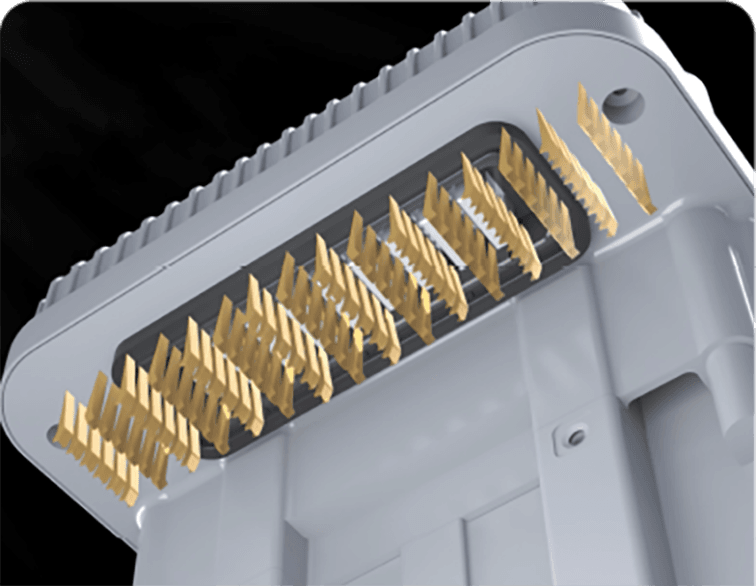
Connector design, heat dissipation, and charger cooling affect fast charging during hot spray seasons
Fast charging is valuable because spray windows are short, but charging safety should stay non-negotiable. Agricultural drone batteries are high-energy systems, and the charging area should be treated as part of the operating site.
The FAA PackSafe guidance for lithium batteries is mainly written for transportation, but it reinforces a useful point for operators: lithium batteries need correct handling, protection from damage, and compliance with rules when moved. The USFA also emphasizes using the correct charger, keeping batteries away from excessive heat, and stopping use if a battery shows warning signs.
For farm teams, practical safety habits include:
- Use only approved batteries and chargers.
- Do not use damaged batteries.
- Do not charge batteries in direct chemical splash zones.
- Keep the charging area dry and ventilated.
- Do not leave charging unattended if the manufacturer's process requires monitoring.
- Keep combustible materials away from the charger.
- Protect connectors from dust, mud, and residue.
- Transport batteries in a way that prevents impact and short circuits.
- Train every crew member on battery warning signs.
If a battery smells unusual, swells, leaks, overheats, shows connector damage, or triggers repeated errors, remove it from service and follow the manufacturer's safety procedure.
Buyer Questions Before Choosing an Agricultural Drone Battery System
Before buying a spray drone, ask these questions:
1. What is the battery capacity?
2. What is the stated charging time, and from what charge range?
3. What is the typical work time under spraying conditions?
4. Does the charger support active cooling?
5. Can the system support two-battery cycling?
6. What ambient temperature range is supported for charging?
7. Can the charger run from a generator?
8. Can it run from standard rural power grids?
9. What charging power is required?
10. How many chargers are needed for two drones?
11. What battery safety protections are built in?
12. Are battery logs available in the app or controller?
13. How are battery errors reported?
14. What is the expected battery service life?
15. How much do replacement batteries cost?
16. Are batteries and chargers available locally?
17. Does training include battery charging and field power setup?
18. What warranty rules apply to battery misuse, overheating, water exposure, or physical damage?
The strongest agricultural drone battery system is not simply the largest battery. It is the system that gives the operator predictable rotation, safe charging, practical power options, and local support.
Conclusion
Agricultural drone battery life is not only an endurance number. It is a productivity system. A buyer needs to understand how long the drone works, how fast the battery charges, whether two-battery cycling is realistic, how heat is managed, and how the field crew will keep charging safe and organized.
For full-day spraying, the best strategy is to model the whole cycle: flight, landing, refill, battery swap, charging, cooling, and route restart. If charging fits inside that cycle, the drone can keep working. If not, the operation needs more batteries, more chargers, better power supply, or a different workflow.
EAVISION's J150 and J70 show how modern agricultural drone charging is becoming a system-level feature. High-capacity batteries, integrated cooling chargers, fast charging, dual-battery cycling, generator support, and service training all contribute to real field productivity.
For farm managers and spray service providers, that is the decision that matters: not the longest single flight, but the most reliable full-day operation.
FAQ
How long does an agricultural drone battery last?
It depends on payload, tank volume, application volume, wind, route shape, temperature, battery age, and the drone model. For spray work, buyers should evaluate both flight time and the full field cycle, including refill and charging.
What is spray drone battery life?
Spray drone battery life can mean single-flight endurance, usable work time under spraying conditions, or long-term battery service life. Operators should clarify which meaning is being discussed.
How many batteries do I need for agricultural drone spraying?
For one drone, a two-battery rotation may work if the charger can recharge one battery before the other finishes its flight and refill cycle. More batteries may be needed for hot weather, short cycles, multiple drones, long distance from the charger, or backup capacity.
What charging time does the EAVISION J150 list?
The J150 specifications list 9 minutes from 30% to 95% under stated conditions. The J150 product page also describes a 9-minute charge for 12-minute flight endurance and dual-battery cycling.
Does hot weather reduce battery productivity?
Hot weather can affect battery discharge, charging, cooling, and operator workflow. A charger with active cooling, shaded charging area, battery logs, and disciplined rotation can help manage the risk.