Drone Fertilizer Spreading: Granule Size, Rate Calibration, and Uniformity


Drone spreading fertilizer is attractive because it can move granular inputs across fields without wheel tracks, soil compaction, or slow manual broadcasting. It is especially useful when the field is wet, the crop is already established, the block is small or irregular, or the farm needs fast topdressing during a narrow application window.
But fertilizer spreading by drone is not only a payload question. A drone with a large hopper can still perform poorly if the material is not suitable, the target rate is wrong, the spread width is not tested, or the operator skips calibration. A good fertilizer spreading drone program should start with granule size, rate calibration, and uniformity.
This guide explains how to evaluate fertilizer material, calculate a target rate, test spread width, check field uniformity, and choose between EAVISION J150 and EAVISION J70 for different operations.
Why Fertilizer Spreading Needs Calibration
Fertilizer is not a single material. Urea, compound fertilizer, coated products, blended products, granules, pellets, and seed-like materials all flow differently. Granule size, bulk density, moisture, dust, coating, and clumping can change how material leaves the hopper and lands on the crop or soil.
That is why rate calibration matters. A drone for spreading fertilizer must deliver the right amount per hectare, acre, or mu. Too little material can reduce crop response. Too much material can waste input, burn crops, increase runoff risk, and create uneven growth.
Calibration should answer four questions:
1. Does this material flow cleanly through the spreading system?
2. What spread width is realistic in this field?
3. What flight speed and hopper flow produce the target rate?
4. Is the field pattern uniform enough after overlap?
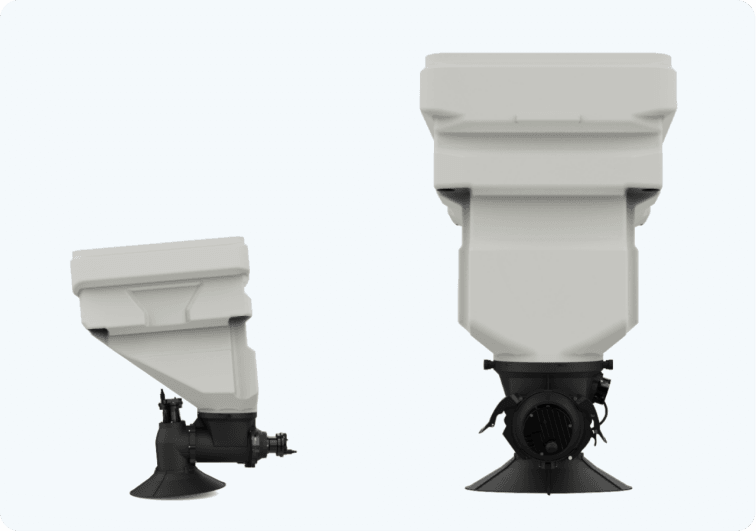
EAVISION's SPD100 spreading system features a 100 L hopper, 80 kg payload, 3-8 m spreading width, and a maximum spreading speed of up to 240 kg/min. Those numbers show capacity, but calibration turns capacity into agronomic accuracy.
1. Match the Fertilizer Material to the Spreading System
Before a full-field job, inspect the fertilizer. Do not assume that every granular product will behave the same way.
Check:
- Granule size range
- Bulk density
- Moisture and clumping
- Dust level
- Coating or prill strength
- Blend separation risk
- Flowability through the hopper
- Sensitivity to wind
- Corrosion or cleaning needs
The SPD100 supports different screw feeder assemblies for different materials, including extra-large, large, and small options for fertilizer, rice seed, wheat, feed, rapeseed, and small granular materials. It is designed for particles in the 1-10 mm size range.
For fertilizer, the key is consistency. A uniform, dry, clean granule is easier to spread than a dusty, wet, sticky, or mixed-size material. If granules bridge in the hopper or separate during vibration, the rate can change during flight.
Run a material fit test before the first job:
1. Fill a small amount of fertilizer.
2. Check whether it flows without bridging.
3. Run a short discharge test.
4. Inspect whether dust builds up.
5. Weigh discharged material.
6. Clean the system and check for corrosion or residue.
Dealers should include this material-fit step in every demo. It prevents buyers from judging a fertilizer spreading drone only by hopper size.
2. Calibrate Rate Before Full-Field Application
Rate calibration converts a fertilizer recommendation into drone settings. The agronomist may recommend 100 kg/ha, 150 kg/ha, or another target rate. The drone operator must translate that into speed, width, and flow.
A useful planning formula is:
Required discharge (kg/min) = Target rate (kg/ha) x spread width (m) x flight speed (m/s) x 60 / 10,000
Example:
Target rate: 120 kg/ha
Spread width: 6 m
Flight speed: 5 m/s
Required discharge = 120 x 6 x 5 x 60 / 10,000
Required discharge = 2.16 kg/min
The drone software may automate parts of this process, but the operator should still understand the relationship. If speed increases, the system must discharge more material to hold the same rate. If spread width narrows, route overlap changes. If material flow slows because of moisture or granule shape, the field may receive less than planned.
A simple calibration workflow:
1. Confirm target rate from the crop plan.
2. Select fertilizer material and feeder setup.
3. Choose a starting spread width.
4. Run a short discharge test and weigh output.
5. Adjust hopper flow or settings.
6. Run a test strip in the field.
7. Check material used against area covered.
8. Adjust speed, width, or flow before full-field work.
For dealer demos, show the calibration step. A buyer who sees a scale, a test strip, and a clear adjustment process will trust the application more than a buyer who only sees a fast flight.
3. Check Uniformity: Width, Overlap, and Field Pattern
Uniformity is the difference between spreading fertilizer and spreading fertilizer well. A field can receive the correct total kilograms but still have bands, skips, or over-applied strips.
Uniformity depends on:
- Material consistency
- Spinner or spreader setting
- Hopper flow
- Flight speed
- Spread width
- Wind
- Route spacing
- Turn behavior
- Overlap pattern
- Terrain and crop height
Use trays, pans, mats, or marked collection zones for a test pattern when possible. Place them across the expected spread width, run the drone over the line, collect material, and compare distribution. If the center receives much more than the edges, overlap may need adjustment. If one side receives more, wind or hardware setup may be affecting the pattern.
Common problems include:
|
Problem |
Likely Cause |
Fix |
|
Heavy center band |
Spread width too wide or material drops too close to center |
Reduce effective width or adjust overlap |
|
Skips between passes |
Route spacing too wide |
Narrow swath or increase overlap |
|
Uneven left/right pattern |
Wind, slope, or hardware setup |
Recheck wind, route direction, and spreader setup |
|
Rate drops during flight |
Bridging, moisture, or hopper flow issue |
Inspect material and feeder |
|
Dust drift |
Poor material quality or high wind |
Change product condition or wait for better weather |
The best operators keep calibration notes for each fertilizer type. Over time, those notes become a local spreading database for the dealer or service provider.
When to Use J150 or J70 for Fertilizer Spreading
EAVISION J150 is the best fit for high-capacity drone spreading fertilizer jobs. It supports an 80 kg maximum spreading payload and up to 280 kg/min maximum spreading speed, while the SPD100 system adds large-capacity spreading capability. For dealers and contractors, J150 is useful when daily workload, route density, and material volume justify a larger platform.
J150 is a strong fit for:
- Larger farms
- Custom spreading services
- Rice, grain, pasture, or broad field topdressing
- High-volume fertilizer routes
- Dealers demonstrating premium spreading capacity
EAVISION J70 may fit smaller jobs. It supports a 50 kg maximum spreading payload and uses a compact platform for spraying, spreading, and lifting. It may suit smaller farms, lighter fertilizer tasks, entry-level dealers, or service providers working in tighter blocks.
The right choice depends on material rate, hectares per day, field size, transport, battery workflow, dealer support, and spare parts availability.
Dealer and Grower Checklist for Fertilizer Spreading Drones
Before buying or selling a fertilizer spreading drone, confirm the full workflow.
|
Area |
What to Verify |
|
Material |
Granule size, flowability, moisture, dust, clumping |
|
Feeder setup |
Correct assembly or hopper setting for the material |
|
Rate |
kg/ha, lb/ac, or kg/mu target and calibration method |
|
Width |
Real spread width under field conditions |
|
Route |
Boundary, swath spacing, wind direction, turns |
|
Uniformity |
Tray test, test strip, or field pattern check |
|
Productivity |
Payload, refill time, batteries, chargers, transport |
|
Maintenance |
Cleaning, corrosion control, wear parts, service records |
|
Support |
Training, original parts, warranty, after-sales support |
Conclusion
Drone spreading fertilizer can improve field access, timing, and labor efficiency, but only when the system is calibrated. Granule size, material flow, rate calculation, spread width, overlap, and uniformity checks decide whether the application is agronomically useful.
EAVISION J150 gives dealers and contractors a high-capacity spreading platform, while EAVISION J70 can support smaller or lighter jobs. In both cases, the best fertilizer spreading drone program includes material testing, rate calibration, route planning, uniformity checks, cleaning, parts, training, and after-sales support.
FAQ
What is drone spreading fertilizer?
Drone spreading fertilizer means using an agricultural drone with a hopper or spreading system to apply granular fertilizer across a field, orchard, paddy, pasture, or other crop area.
What granule size works best for a fertilizer spreading drone?
Uniform, dry, free-flowing granules usually work best. EAVISION's SPD100 spreading solution lists a suitable particle size range of 1-10 mm, but operators should still test each material before full-field application.
How do you calibrate fertilizer rate for a drone?
Confirm the target rate, spread width, and flight speed, then test discharge and field pattern. A planning formula is target rate x spread width x speed x 60 / 10,000 = required kg/min for kg/ha.
Why is uniformity important in drone fertilizer spreading?
Uniformity prevents strips, skips, and over-applied zones. Poor uniformity can waste fertilizer, create uneven crop growth, and reduce the value of drone application.
Is J150 or J70 better for fertilizer spreading?
J150 is better for higher-capacity jobs and commercial spreading services. J70 can fit smaller farms, lighter routes, and entry-level demo programs. The right choice depends on rate, material, field size, workload, and support.