How Agricultural Drones Reduce Pesticide Runoff and Chemical Drift


Pesticide drift and runoff have long plagued conventional agriculture. When chemicals miss their target, drifting onto neighboring fields or waterways, or settling into the soil beyond the root zone, farmers lose money, ecosystems suffer, and regulatory pressure mounts. For growers across the world, the question is no longer whether to address chemical drift, but how to do so without sacrificing productivity.
Agricultural drones have emerged as one of the most effective answers. By combining intelligent flight control, precision spraying technology, and real-time environmental awareness, modern agricultural drones are dramatically reducing the volume of pesticides that escape their intended targets.
Understanding the Drift and Runoff Problem
Chemical drift occurs when pesticide droplets, particularly fine droplets, are carried by wind away from the treatment zone. Runoff happens when excess spray volume saturates foliage and soil, washing chemicals into waterways during rain or irrigation. Traditional ground rigs and manned aerial spraying contribute to both problems through:
- Oversaturation caused by uniform application rates that ignore canopy variability and terrain.
- Uncontrolled droplet sizes, where fine droplets drift kilometers away while oversized droplets pool and run off.
- Poor targeting in orchards, hillsides, and irregular fields where ground equipment can't follow the canopy precisely.
The economic cost is significant: studies suggest 30–50% of conventionally applied pesticides never reach their biological target. The environmental cost, including contaminated rivers, pollinator decline, and soil residue, is even greater.
How Drones Address the Root Causes
1. Precision Droplet Control
The single biggest factor in drift reduction is droplet size management. Droplets smaller than 100μm drift easily; droplets above 300μm tend to run off. The sweet spot varies by crop, chemical, and weather conditions.
EAVISION's spraying systems offer continuously adjustable droplet sizes from 10 to 300μm, allowing operators to match droplet size precisely to the application. For systemic herbicides on grain crops, larger droplets minimize drift. For contact fungicides on dense orchard canopies, finer droplets ensure coverage without runoff. This adaptability is something neither boom sprayers nor manned aircraft can replicate in real time.
2. Canopy-Following Flight
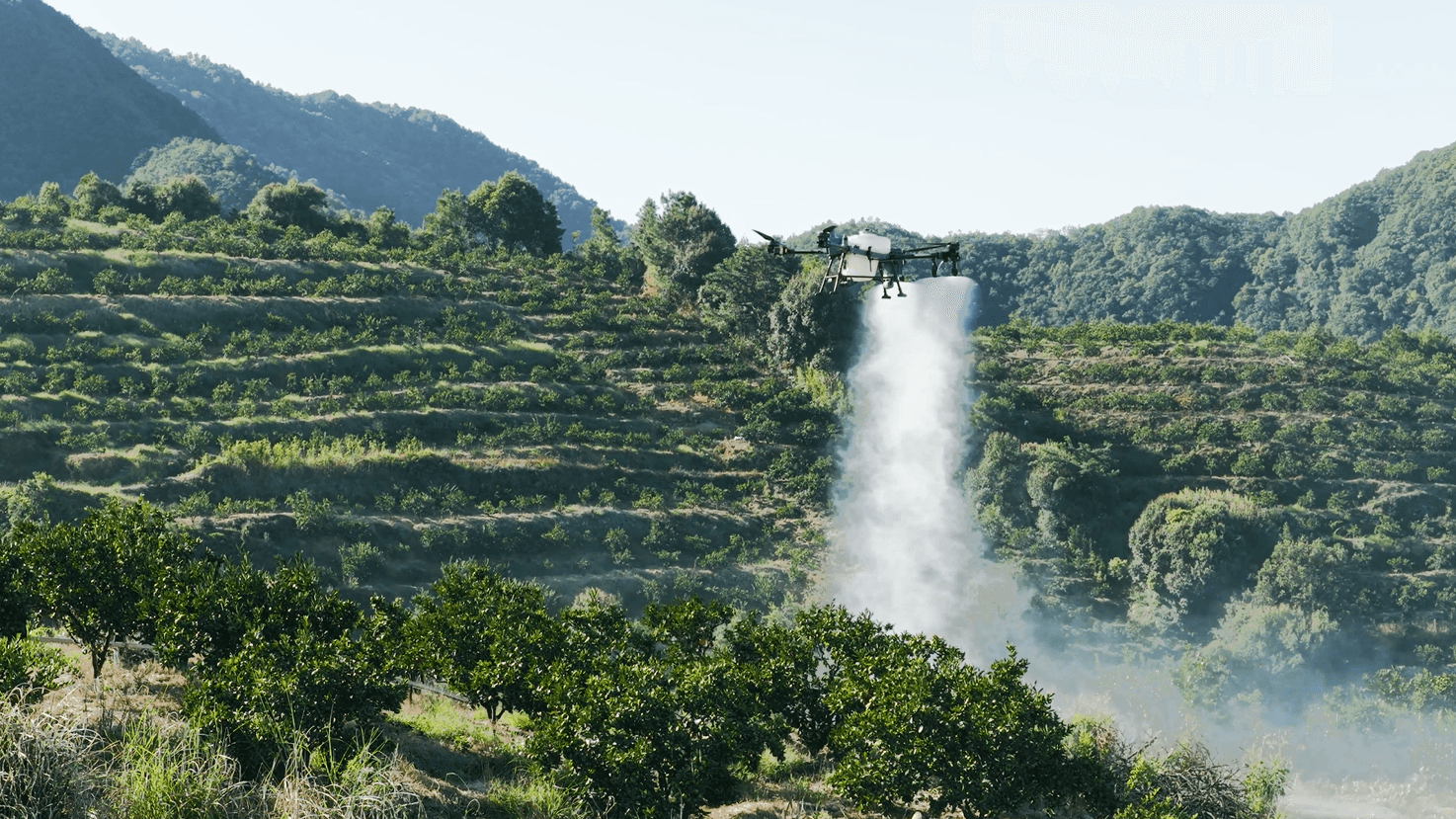
Drift increases dramatically with spray height. Every additional meter between the nozzle and target gives wind more time to carry droplets off-course. Drones equipped with 3D terrain recognition fly just above the canopy, typically 1.5 to 3 meters high, regardless of slope or tree height.
The EA-J150, for example, uses autonomous recognition of complex terrain combined with real-time obstacle avoidance to maintain consistent spray height across orchards, vineyards, and hillside plantations. This precision is especially valuable for citrus growers, coffee plantations, and tea estates, where uneven terrain has historically forced compromises in application quality.
3. Variable Rate Application
3D mapping technology allows drones to identify canopy density, crop health, and field boundaries before spraying begins. The drone then adjusts the flow rate dynamically, applying more chemical where pest pressure is high and less where coverage is already sufficient. This eliminates the blanket overspray that drives most runoff events.
For solo operators or smaller farms, the EA-J70 brings these same precision capabilities to single-pilot missions, making advanced drift-reduction technology accessible to growers who previously couldn't justify large-scale equipment.
4. Downwash Penetration Without Overspray
Multirotor drones generate a controlled downwash that pushes droplets into the canopy from above, improving penetration into the underside of leaves where many pests reside. Because the airflow is directed downward rather than outward, lateral drift is significantly reduced compared to ground-based mist blowers, which throw spray sideways into the wind.
Quantifiable Reductions
Field trials and grower data consistently show that precision drone spraying delivers:
- Significant reductions in total pesticide use compared to conventional ground spraying, thanks to more precise targeting and controlled application.
- Substantially lower chemical drift when using optimized droplet sizes and terrain-following flight technology.
- Significant runoff reduction, since lower application volumes mean less chemical available to wash off during rain events.
- Improved efficacy, as more of the active ingredient actually reaches the pest.
Conclusion
As pesticide regulations tighten globally and consumer demand for sustainably grown produce continues to rise, the pressure to reduce chemical drift and runoff will only intensify. Agricultural drones offer a rare combination of better environmental outcomes, lower input costs, and improved crop protection, all from the same technology.
For farms ready to take the next step, exploring purpose-built solutions like those in the EAVISION product lineup is a practical starting point toward cleaner, more profitable, and more responsible crop protection.
FAQs
1. What is agricultural drone pesticide drift?
Agricultural drone pesticide drift refers to pesticide droplets moving away from the target crop area during application. This usually happens due to wind, improper droplet size, or excessive spray height, leading to chemical loss and environmental contamination.
2. How do agricultural drones reduce pesticide drift?
Agricultural drones reduce drift by flying at ultra-low altitudes, using precise droplet control systems, and maintaining consistent spray height through terrain-following technology. This minimizes wind exposure and keeps droplets closer to the crop canopy.
3. Do agricultural drones reduce pesticide runoff?
Yes. Agricultural drones reduce runoff by applying more targeted and lower-volume sprays. Because chemicals are distributed more precisely on plant surfaces rather than oversaturating soil, less pesticide is washed away by rain or irrigation.
4. Are drones more accurate than traditional sprayers?
In most complex terrains, such as orchards, vineyards, and hillsides, drones are significantly more accurate. They can adjust flight height and spray output in real time, while traditional ground sprayers often apply uniform coverage regardless of crop variability.
5. Can agricultural drones be used in orchards and hilly terrain?
Yes. Agricultural drones are especially effective in orchards, vineyards, and sloped farmland because they use terrain-following systems that maintain stable spray height even on uneven ground.