Rice Drone Spraying: Why Paddies Are the Ideal Use Case for Agricultural Drones


Rice feeds more than half the planet. But here's a problem most people outside the industry don't think about: protecting a rice crop is brutal, slow, and increasingly hard to staff. The average rice farmer in Asia spends eight hours a day navigating muddy paddy fields in hot, humid conditions while carrying a heavy backpack sprayer just to cover one hectare. That is the reality they face every day. And that reality isn't limited to Asia anymore. From Latin America to South Africa to Southern Europe, rice growers face the same bottleneck.
Rice drone spraying is changing that equation fast. And honestly, paddy fields might be the single best environment to deploy agricultural drones. Here's why.
1. Paddy Fields Are Hard to Walk, Easy to Fly Over
The problem with ground spraying:
- Most grain crops let you drive a tractor between rows. Rice paddies don't cooperate like that.
- Flooded fields, ankle-deep mud, and dense canopies make ground-based spraying a nightmare.
- Traditional spraying operations in paddy fields are dangerous as operators must deal with prolonged and frequent exposure to toxic chemicals.
Why agricultural drones win:
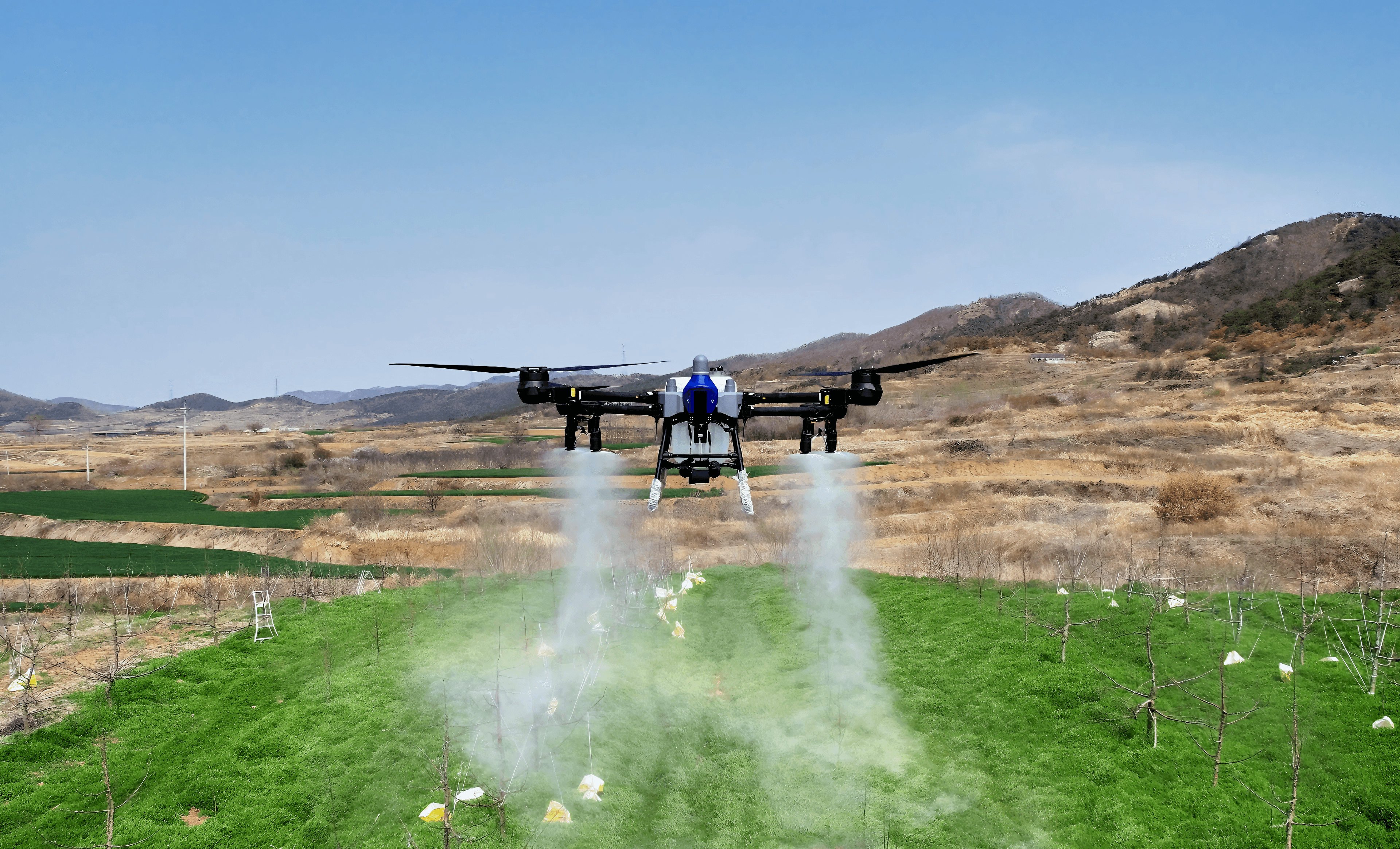
- A drone doesn't care about standing water.
- It flies a pre-programmed route above the canopy, applies the right dose, and moves on.
- No sinking boots. No chemical exposure.
For rice operations specifically, paddy field drone application removes the biggest physical barrier that's existed in this crop for centuries.
2. Why the Rotor Downdraft Matters for Rice
Here's a detail that doesn't get enough attention. The downdraft air stream of the rotors pushes the plant canopy open so that spray droplets can reach the base of the plant, providing more efficient and comprehensive protection. In rice, where diseases like leaf blast attack from the bottom up, canopy penetration offers a clear advantage over top-down-only spraying from fixed-wing aircraft.
3. The Labor Crisis Makes This Urgent
This isn't just about convenience. The younger generation's lack of interest in taking on this kind of manual work raises the average age of the modern farmer and threatens future succession. We see this across Southeast Asia, Latin America, and parts of Southern Europe. In these regions, rice is a major crop, but farm labor is thinning out fast.
Drones save time and labor, ease drudgery, help older farmers remain active, make agriculture more attractive to youth, and free farmers to pursue other employment. The shift from backpack sprayer to drone pilot is not just nice to have. It is essential for the future of rice production.
4. The Market Is Moving Quickly
In the U.S., the number of agricultural drones registered with the Federal Aviation Authority jumped from 1,000 in January 2024 to almost 5,500 in July 2025. Globally, the agricultural drone market is expanding rapidly, reflecting strong adoption across modern precision agriculture systems.
Rice has been at the center of this growth from the start. In Japan, about 2,800 unmanned helicopters were registered as of March 2016, spraying more than a third of the country's rice fields. And that was nearly a decade ago. Today, drone-based rice crop management is standard practice across China, Japan, Korea, and increasingly in Southeast Asia, Latin America, and Africa.
The Numbers Actually Back This Up
We're not talking vague "efficiency gains" here. Real field data from multiple rice-growing regions paints a clear picture:
|
Metric |
Manual/Traditional |
Drone Application |
|
Coverage speed |
~1 hectare / 8 hours |
4× faster than manual |
|
Yield impact |
Baseline |
Up to 14% improvement |
|
Pesticide reduction |
Baseline |
25–30% less chemical used |
|
Water use |
~500 μm droplets |
~50 μm droplets (80–90% less water) |
|
Seed savings (direct seeding) |
Baseline |
Up to 35% fewer seeds |
According to field data from Vietnam's Mekong Delta, agricultural drones can spray crops 4 times faster than manual labor while improving yield by 14%. Field data show that drone spraying provides uniform coverage, leading to a 25 to 30 percent decrease in pesticide and herbicide use. It also conserves water significantly by using droplets of around 50 µm compared to 500 µm in manual spraying, resulting in an 80 to 90 percent reduction in water consumption.
Those aren't lab numbers. That's what actual rice farmers are reporting.
What to Look for in a Rice Spraying Drone
Not every agricultural drone handles paddy conditions well. If you're evaluating options for your rice operation or service fleet, here's what matters:
- Adjustable droplet size: Rice requires different spray profiles at different stages. Look for 10–300μm range.
- Autonomous flight with obstacle avoidance: Paddy fields near tree lines, power lines, or uneven terrain need real-time path correction.
- High-capacity tank: A 70L tank, like on the EAVISION J150, means fewer refill stops and more acres covered per sortie.
- LiDAR-based terrain following: Water surfaces can confuse radar. LiDAR doesn't have that problem.
Related article: Crop Spraying: How to Pick the Right One for Your Farm
Key Takeaways
Rice drone spraying isn't experimental anymore. It's working at scale in the world's biggest rice-producing regions. Paddy fields are uniquely suited for drone application because the very things that make them hard to work manually (standing water, mud, dense canopy) are non-issues for a drone flying overhead.
For agricultural service providers and farm managers looking at ROI: faster coverage, lower input costs, better yields, and a workforce that actually wants to show up. That's a solid business case by any measure.
FAQs
How many hectares can a drone spray per day on rice paddies?
It depends on tank size and field layout. High-performance commercial ag drones cover 20–40 hectares per day on flat rice paddies. EAVISION's J150, with its 70L tank and 30 MPH max speed, sits at the higher end of that range, especially on large, open fields.
Is drone spraying on rice as effective as ground application?
Research at California's Rice Experiment Station found that drone applications achieved over 90% weed control efficacy, and the weed control from the drone was similar to control from ground application. The results are comparable, with the added benefit of zero crop trampling.
What regulations apply to rice drone spraying in the U.S.?
Drones over 50 pounds require a Federal Aviation Administration permit, and spray drones need a state Department of Pesticide Regulation permit regardless of weight. Regulations vary by state and by country, so check local requirements before operating.
Can drones do more than just spray pesticides on rice?
Yes. Modern ag drones handle direct seeding, fertilizer broadcasting, and crop health monitoring. In Vietnam field trials, one hectare of rice was sown by drone in two hours with 160 kilograms of seeds that had nearly 100% germination, and the paddy reaped 8 metric tons per hectare while saving seeds by 35%.
Does EAVISION offer drones suited for rice operations?
Absolutely. EAVISION's grain crop solutions are purpose-built for rice, wheat, and corn, with adjustable droplet sizes from 10 to 300μm, autonomous flight, and obstacle avoidance. The EA-J150 is a strong fit for paddy field drone application at scale.