Overview
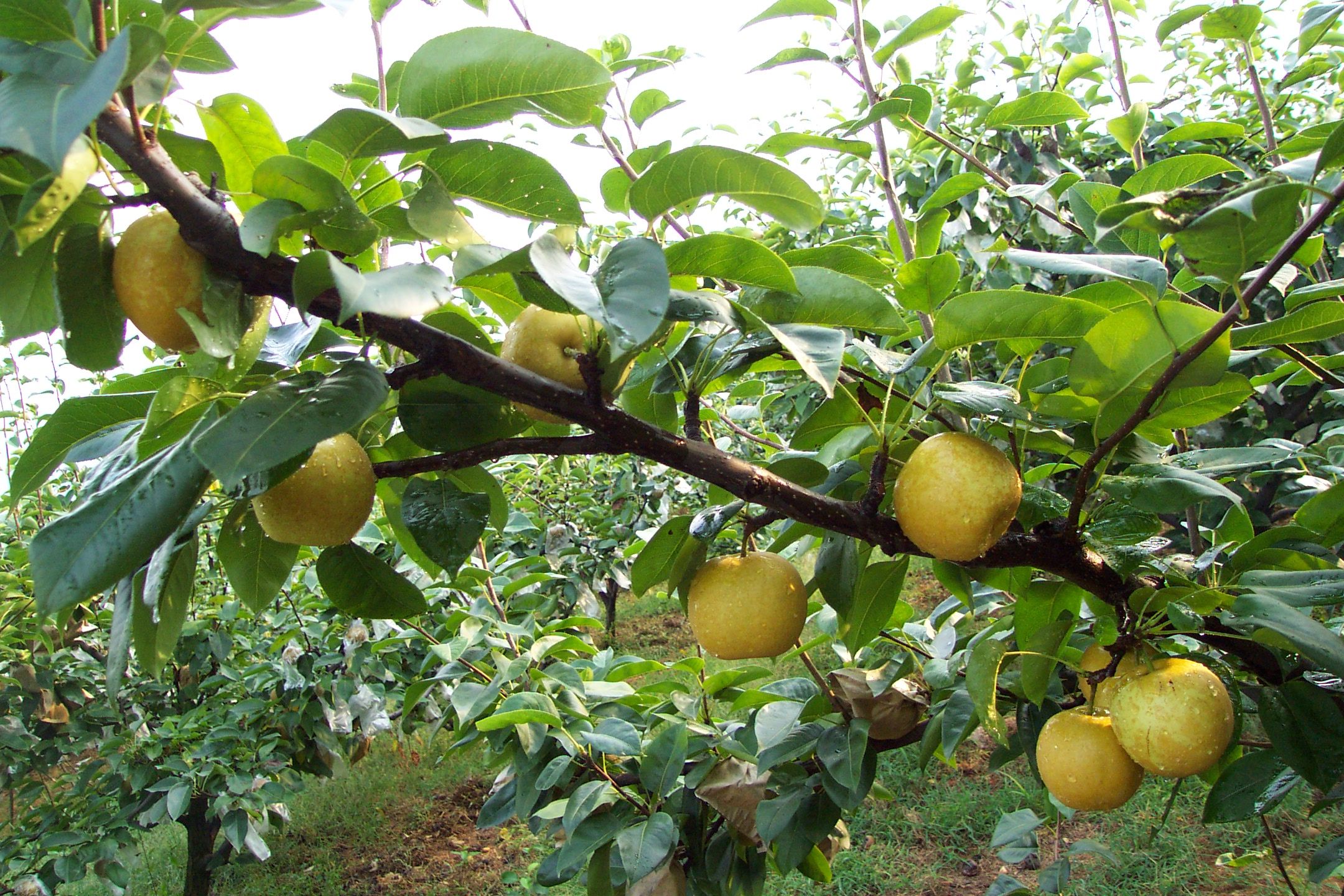
Pear (Pyrus spp.) is a perennial, deciduous fruit tree in the Rosaceae family. It is one of the world’s major fruit crops, with 7,000+ cultivars globally and 3,500+ in China. Trees vary in height by cultivar and management; leaves are alternate with serrated margins. The pome-shaped fruit occurs in round, oblate, oval and pyriform forms. Pear trees are adaptable (tolerant of cold, moisture, and full sun) and grow on plains, hillsides, and lowlands with modest soil requirements.
They are long-lived (often >100 years) with deep, vigorous root systems (vertical roots >2–3 m; lateral roots ≈ twice the canopy spread). Many cultivars bear in year 2–3 and can maintain a 50+ year peak production period.
Origin & Spread
Origin
Pear is native to China with ~3,000 years of cultivation history. Archaeological finds include pear fruits and bamboo slips referencing pears from a 2,100-year-old Han-dynasty tomb at Mawangdui (1972).
Scholarly work suggests an origin in south-western China, followed by diffusion elsewhere. China’s pears are commonly grouped into Aki-nashi (Asian sand pear), Bai-li (white pear), and Sha-li (sand pear) lineages, with sand pear likely domesticated earliest.
Spread
Global spread
As early as the Han dynasty, pears spread to India and Central Asia. From the 18th century onward, Europe and North America repeatedly introduced Chinese pear germplasm to improve fruit quality and pest/disease resistance; by the 19th century Chinese pears were grown widely in the West and Japan.
Into China
European pear cultivation in China dates back ~100+ years. Around 1870, American missionaries introduced nursery stock to Yantai (Shandong), where it performed well and then spread across Yantai, Fushan, and Mouping, forming China’s principal European-pear zone.
Nutrition & Wellness
-
Vitamins & minerals: Rich in micronutrients. For example, Nanguo pear per 100 g edible portion: vitamin C 6.8 mg, potassium 128 mg.
-
Dietary fiber: Abundant; Nanguo pears contain 3.1 g/100 g. The gritty “stone cells” are a sclereid form of dietary fiber.
-
Bioactives: Polyphenols and flavonoids with antioxidant activity (Nanguo: total polyphenols 186 mg GAE/100 g FW, flavonoids 52 mg RE/100 g FW).
-
Sugars & acidity: Predominantly fructose, glucose, sucrose. Nanguo totals ~12.3 g/100 g (fructose 6.1 g, glucose 4.2 g, sucrose 2.0 g). At full maturity, sugar-to-acid ratios > 35:1 deliver optimal flavor.
-
TCM note: In Traditional Chinese Medicine, pears are said to “clear wind-heat, moisten the lung and heart, resolve phlegm and inflammation, and detoxify.” (TCM concepts; not claims of Western medical efficacy.)
Economic Value
-
Industry scale: China’s pear industry output value has exceeded CNY 70 billion for two consecutive years, reaching CNY 76.69 billion in 2023; planted area > 13 million mu; total output > 20 million tons.
-
Trade: Clear net-export profile. In 2024, exports were 751.4 thousand tons, US$736 million, with a US$715 million surplus.
-
Regional economies: In some areas pears are pillar industries—for example, Dangshan crisp pear brand value CNY 19.064 billion, full-chain output value CNY 11.035 billion.
Pear Production in China at a Glance
-
Area: 2023 national pear acreage 13.386 million mu (≈ 7.01% of total orchard area).
-
Output: 2024 production 20.9879 million tons (≈ 6.18% of national fruit output).
Key Producing Regions
|
Region |
Planted Area |
Output |
Main Cultivars |
Industry Notes |
|
Hebei |
1.662 million mu |
3.9568 million t |
Yali, Xuehuali |
Largest pear acreage and output in China. |
|
Xinjiang |
1.023 million mu |
1.6092 million t |
Korla Fragrant Pear |
Specialty pear region; Korla pear prices show an upward trend. |
|
Liaoning |
1.1895 million mu |
1.2636 million t |
Nanguo Pear |
Specialty region; Nanguo pears have a distinctive aroma. |
|
Anhui |
0.6135 million mu |
1.4172 million t |
Dangshan Crisp Pear |
High brand value; full industry chain output > CNY 11 billion. |
|
Shanxi |
0.804 million mu |
1.5262 million t |
Hongxiao Pear, Honey Pear |
Among the leading provinces by pear output. |
Industry Traits & Challenges
Traits
-
Science-driven gains: Over the past decade, production shifted from area expansion to yield-driven growth; since 2022, average yield has exceeded 1,400 kg/mu, enabled by cultivar renewal, management optimization, and technology adoption.
-
Cultivar diversity: Major cultivars include Dangshan crisp pear, Yali, Xuehuali, Korla fragrant pear, Cuiguan, etc.
Challenges
-
Disease/pest complexity: Common threats (e.g., pear scab, anthracnose, rust, canker, Botryosphaeria canker; pear fruit moth, pear psyllid, stem sawfly, aphids, scarabs).
-
Fragmented control & timing issues: Predominantly smallholder operations with non-synchronized spraying leave refuges and reduce efficacy; timing is difficult due to weather-driven peaks (e.g., three scab peaks around April rainy spells, June rainy season, and July–Sept typhoons).
-
Labor constraints: Out-migration leaves an aging workforce with limited crop-protection training—higher costs, lower efficacy.
-
Losses when control fails: Early defoliation, weakened trees, fruit infections and even crop failure → lower yields and poorer market quality.
Major Diseases and Pests
Key Diseases
1) Pear Scab
Symptoms: One of the most serious diseases; typically three seasonal peaks (April rainy period; June rainy season; and July–Sept typhoon weather).
Control Essentials
-
Chemical: Trials show prochloraz (azole) SC provided strong efficacy—~85.22% on leaves and ~77.06% on fruit during tests.
-
Cultural: Winter sanitation; pruning to improve canopy ventilation and light.
2) Pear Rust
Symptoms: Common disease of leaves and fruit.
Control Essentials
-
Cultural: Remove nearby junipers and other alternate hosts to break the cycle.
-
Chemical: Apply appropriate fungicides at first symptoms.
3) Pear Botryosphaeria Canker (Ring Rot)
Symptoms: Attacks shoots/branches and fruit → decline and fruit rot.
Control Essentials
-
Cultural: Strengthen orchard management; remove infected twigs and fruits promptly.
-
Chemical: Protective sprays at early infection.
Key Pests
1) Pear Fruit Moth (Grapholita spp.)
Notes: Major pest with local adult peaks around mid-May, late June, and early–mid August.
Control Essentials
-
Mating disruption: Using pheromone twist-ties achieved 96.17% disruption and 90.32% reduction in wormy fruit in trials.
-
Chemical: Target sprays at oviposition and egg-hatch peaks.
2) Pear Psyllid (Cacopsylla spp.)
Notes: One of the most damaging pests; adults show 2–3 peaks per year (e.g., late April–mid May, late May–mid June, late June–early July).
Control Essentials
-
Cultural: Remove weeds and leaf litter to reduce overwintering sites.
-
Chemical: Spray promptly at nymphal peaks.
3) Pear Stem Sawfly
Symptoms: Damages tender shoots, stunting new growth.
Control Essentials
-
Physical: Prune out infested shoots and destroy them.
-
Chemical: Spray during adult flight.
Recommended Operation Parameters
|
Target pest/disease |
Application rate |
Droplet size |
Flight height |
Flight speed |
Route spacing |
|
Pear Psyllid |
6–12 L/mu (≈ 90–180 L/ha; ≈ 37–73 L/acre) |
≈ 60 µm |
≈ 4–5 m above canopy |
4–4.5 m/s |
≈ 4–5 m |
The parameters above are for reference only. Please adjust the operation settings to the actual crop growth stage, field conditions, and equipment model.
These parameters are derived from trials in major pear-growing regions. Pest and disease incidence varies by region and season—select and apply pesticides as required.
Why J100 for Pears — Precise Coverage, Higher Marketable Yield
In Liaoning’s premium pear belts, the J100 delivers precise crop protection for key pests (fruit moth, psyllid) and diseases (scab, rust). With a powerful downwash and accurate spray system, droplets penetrate to the canopy tops and interior, achieving true three-dimensional control and solving the traditional “can’t reach/uneven coverage” pain point. Technology-enabled protection helps growers reduce costs and increase efficiency, safeguarding the quality and value of every pear.