Overview
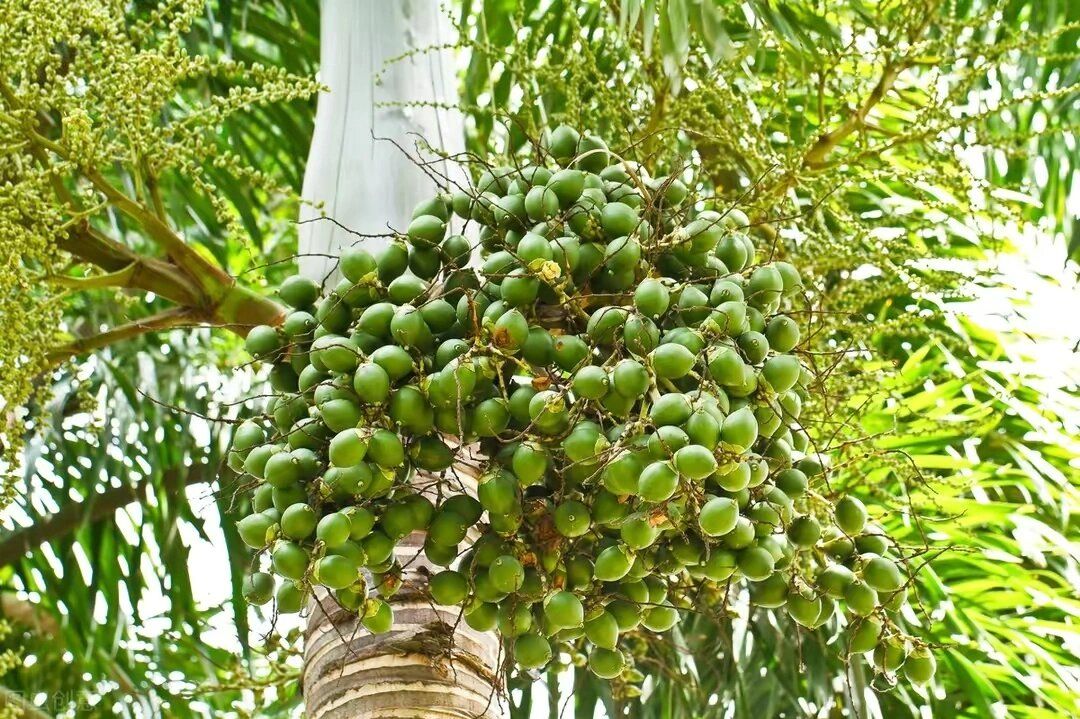
Areca palm (Areca catechu) is an evergreen palm reaching 10–30 m with conspicuous ringed leaf scars. Crowns carry many narrow-lanceolate pinnae; fruits are elliptic to ovoid, turning orange-yellow at maturity.
Distribution. Native to Southeast Asia’s tropical belt, now planted across many tropical regions. In China it is concentrated in Hainan, Yunnan, and Taiwan.
Health advisory. The WHO/IARC classifies betel nut (areca) chewing as a Group 1 carcinogen. Habitual chewing damages teeth and dramatically raises oral-cancer risk; addiction is driven by arecoline. Messaging around cultivation should avoid encouraging consumption.
Origin & Spread
Origin
Native to the Malay Archipelago. Archaeological finds (e.g., NW Thailand) indicate very early cultivation—traces date back many millennia.
Global Spread
Classical and early texts across South Asia reference chewing areca; over centuries the crop spread through tropical Asia, parts of East Africa, and into limited European use.
Into China
First noted in literature as early as the Western Han (Sima Xiangru’s Shanglin Fu). After the Han–Nanyue campaigns, knowledge of areca reached the north; by the Wei–Jin to Tang–Five Dynasties period, tribute from Southeast Asian polities popularized it among elites.
Spread with China
Planting expanded markedly in Ming–Qing, especially in Qiongzhou (Hainan). Today it remains concentrated in Hainan, Yunnan, Taiwan.
Composition, Uses & Risks
Bioactive profile. Seeds contain 0.3–0.6% total alkaloids (primarily arecoline 0.1–0.5%, plus related alkaloids), ~15% condensed tannins, ~14% fats, and pigments (e.g., areca red).
Traditional uses (TCM). Seeds, pericarp, and flowers are recorded for actions such as anthelmintic, moving qi, and draining damp (historical notes; follow local regulations for medical claims).
Reported pharmacology (research stage). GI motility stimulation, antioxidant activity of areca polyphenols, anthelmintic effects, and other exploratory activities have been published—not safety endorsements for chewing.
Health risk (critical). Areca chewing is carcinogenic (IARC Group 1) and addictive; it should not be promoted for consumption.
Areca Palm in China at a Glance
-
Scale & Output
-
Global: ~16 million mu under cultivation; ~700 million people consume areca products in various forms.
-
China: 1.6–1.8 million mu, with Hainan >1.4 million mu (primary zone).
-
Key Regions
Region
Planting Traits
Industry Contribution
Hainan
Core belt; >1.4M mu
Second only to rubber in local cash crops
Yunnan
Tropical pockets
Traditional growing areas
Taiwan
Important belt
Second to rice in some local economies
-
Industry Traits & Challenges
Traits
-
Genomics & tech: 2021 genome assembly by CATAS Coconut Institute + BGI improved genetic resources.
-
Grower dependence: A major income source for many Hainan smallholders.
-
Policy/regulation: Heightened scrutiny due to health concerns; industry transition is urgent.
Core challenge — Plant-health protection at scale
-
Complex pest/disease dynamics: Weather-linked outbreaks (e.g., red-veined spike borer) complicate forecasting.
-
Terrain & height constraints: Steep terrain and tall canopies hinder ground sprayers.
-
Labor & cost pressure: Limited labor availability raises control costs and delays response.
-
Direct losses: Poor control cuts fruit set/yield and downgrades quality, compressing margins.
Major Diseases & Pests
Key Diseases
Leaf spot complex
-
Symptoms: Small spots coalescing into irregular large lesions → premature leaf senescence and reduced photosynthesis.
-
Control essentials: Rational spacing and airflow; remove diseased leaves; treat early with labeled DMI/copper/ETU alternatives (e.g., prochloraz, mancozeb) per local guidance.
Anthracnose
-
Symptoms: Sunken fruit lesions; pinkish spore masses in humid weather; fruit drop.
-
Control essentials: Labeled fungicides (e.g., benzovindiflupyr, prochloraz), plus foliar nutrition to support recovery.
Key Insect
Red-veined spike borer
-
Damage: Larvae bore inflorescences and young fruits, causing spike blight, fruit drop, and galls—severe yield/quality loss.
-
Control essentials: Frequent scouting and sanitation; targeted insecticides/attract-and-kill where permitted; conserve natural enemies.
Recommended Operation Parameters
|
Target pest/disease |
Application rate |
Droplet size |
Flight height |
Flight speed |
Route spacing |
Anthracnose |
8–20 L/mu (≈ 120–300 L/ha; ≈ 49–121 L/acre) |
≈ 40 μm |
≈ 3–5 m above canopy |
2.5–4.0 m/s |
≈ 4–5 m |
The parameters above are for reference only. Please adjust the operation settings to the actual crop growth stage, field conditions, and equipment model.
These parameters are derived from trials in major areca-growing regions. Pest and disease incidence varies by region and season—select and apply pesticides as required.
Why J100 for Areca — Penetration, Timing, and Cost Control
In Sanya, Hainan, the EAVISION J100 precision agriculture drones is addressing height and terrain barriers in areca orchards. Precise flight control and powerful downwash deliver uniform coverage on both leaf surfaces and deep into high crowns—supporting effective control of anthracnose and the red-veined spike borer, while enabling foliar nutrition where appropriate. High-efficiency missions improve response speed and help curb yellowing decline, stabilizing yield and protecting the sustainability of the local areca sector.