Overview
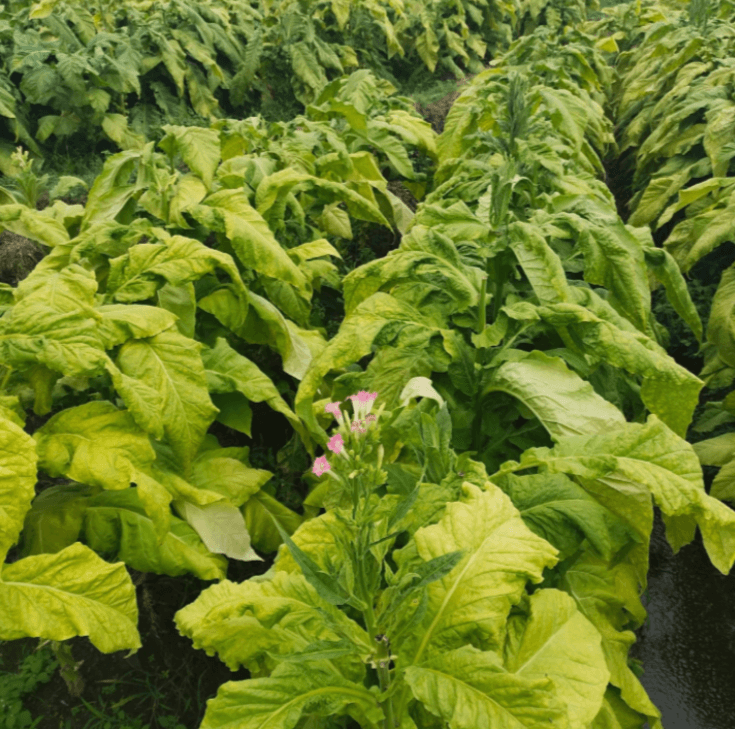
Tobacco (Nicotiana tabacum) is an annual in the Solanaceae family and a major global cash crop. Plants stand 1–2 m tall with upright stems and large, thick leaves—the primary economic organ. Flowers are funnel-shaped, typically pale pink or yellow. By use/curing type, tobacco includes flue-cured, sun-cured, air-cured, burley, and aromatic types, with flue-cured dominant in China. Leaves contain nicotine, the key stimulant and habit-forming alkaloid.
Origin & Spread
Origin
Native to the Americas. Archaeology shows Indigenous use ~3,500 years ago; a Maya “smoking priest” relief (A.D. 432, Chiapas) is among the earliest depictions. In Indigenous cultures tobacco was a “sacred herb,” used in rituals, healing, and councils.
Global spread
After 1492, explorers brought tobacco to Europe. The French envoy Jean Nicot promoted it medicinally—nicotine later bore his name. In the 16th–17th centuries, tobacco spread from Europe to Asia and Africa, becoming a global crop.
Spread with China
Arrived in the late Ming (Wanli period) via four routes: Philippines→Fujian, Vietnam→Guangdong, Japan→Korea→Liaodong, and Russia→Mongolia→Xinjiang. By ~1750, tobacco was grown nationwide with large trade networks.
Applications & Value
-
Bioactives & industrial use. Tobacco contains solanesol (a precursor for cardiovascular, anti-ulcer, anti-tumor pharmaceuticals). Proteins extracted from tobacco leaves have high nutritional value; tobacco buds provide aromatic compounds for flavors & fragrances; pectin from stems serves the food, pharma, and light industries.
-
Bioreactor. Modern plant-made pharming uses tobacco to produce therapeutic proteins, antibodies, and vaccines (e.g., interferon-α, insulin, anti-rabies antibodies, hepatitis B vaccines).
-
Economic & cultural role. Coordinated grower networks (“party branch + cooperatives + farmers”) raise incomes—e.g., Liandeng Village (Yunlong, Dali) reports >RMB 160,000 per household on average. In Guiyang County, Hunan, RMB 270 million in 2024 leaf tax supported local finance. Culturally, tobacco figured in Ming–Qing social life, etiquette, and minority customs.
Tobacco Production in China at a Glance
-
Scale & Output
-
China remains one of the world’s largest tobacco producers with stable planted area.
-
Guiyang County, Hunan (2025): 250,200 mu flue-cured tobacco; ~667,000 dan projected procurement.
-
Yunnan: China’s largest premium leaf base; “Yunyan” series accounts for >70% of national planting.
-
-
Key Regions (examples)
Region
Production Traits
Main Varieties
Industry Contribution
Yunnan
Eco-friendly fields; digital tech adoption
Yunyan 87, Yunyan 97
“Yunyan” series >70% of China
Guiyang, Hunan
Specialized services; infrastructure
Premium flue-cured
RMB 270M leaf tax (2024)
Others
Grain–tobacco rotation; circular ag
Diverse
Income uplift for smallholders
-
Industry Traits & Challenges
Traits — UAVs, 3S tech, and “smart tobacco” platforms enable real-time monitoring (e.g., high-standard smart fields in Heqing and Xiangyun, Dali). Breeding innovation continues (national bio-breeding center launched in Yunnan, 2024; “Yunyan” series dominant). Grower linkage (“branch + coop + households”) drives scale, drip irrigation, rail carts, and mechanization to cut costs.
Challenges —-
Diverse pathogens & pests: surveys report 19 common diseases in Jiangxi alone (e.g., black shank, brown spot, bacterial wilt), spanning fungal, bacterial, and viral groups.
-
Residues & environment: misuse risks MRL exceedance and packaging waste pollution.
-
High control cost & resistance: repeated single-chemistry use selects resistance, raises costs, and heightens outbreak risk.
-
Major Diseases & Pests
Key Diseases
Black shank
-
Damage: Fungal infection at stem base/roots → wilt and death; white mycelium under humid conditions.
-
Control essentials: Resistant varieties, rotation, rogue infected plants; phenylamide fungicides (e.g., metalaxyl) at early onset per label.
Brown spot
-
Damage: Circular/irregular lesions with distinct margins and brown centers; coalescence causes leaf blight.
-
Control essentials: Rational spacing & airflow, balanced nutrition; treat early with mancozeb or other labeled fungicides.
Bacterial wilt
-
Damage: Leaves remain green yet wilt; vascular browning; milky bacterial ooze on cross-sections.
-
Control essentials: Resistant varieties, paddy–upland rotation, biocontrol soil treatments; early streptomycin drenches per local regulation.
Key Insect Pests
Tobacco budworm (Helicoverpa armigera)
-
Damage: Larvae notch/defoliate leaves; also attack buds and capsules.
-
Control essentials: Light traps, pheromone lures; treat early instars with emamectin or Bacillus thuringiensis per label.
Common cutworm / Spodoptera litura
-
Damage: Voracious defoliator; outbreaks can strip fields rapidly.
-
Control essentials: Hand-remove egg masses and gregarious larvae; conserve natural enemies; treat early instars with chlorfenapyr, indoxacarb, etc., per label.
Recommended Operation Parameters
|
Target pest/disease |
Application rate |
Droplet size |
Flight height |
Flight speed |
Route spacing |
Tobacco Cutworm |
3–6 L/mu (≈ 45–90 L/ha; ≈ 18–36 L/acre) |
≈ 60 μm |
≈ 4–6 m above canopy |
4–6 m/s |
≈ 4–5 m |
The parameters above are for reference only. Please adjust the operation settings to the actual crop growth stage, field conditions, and equipment model.
These parameters are derived from trials in major tobacco-growing regions. Pest and disease incidence varies by region and season—select and apply pesticides as required.
Why J100 for Tobacco — Stable Yields, Better Returns
In the rugged fields of the Yunnan–Guizhou Plateau, the EAVISION J100 is redefining plant protection. Powerful rotor downwash and a precision spray system deliver uniform, 3D deposition across the tobacco canopy—solving uneven coverage and missed windows typical of manual or ground spraying. The J100 enables timely, targeted control of major diseases (black shank, brown spot, bacterial wilt) and pests (budworm, Spodoptera litura), helping growers reduce costs, raise efficiency, and safeguard the value of every “golden leaf.”