Overview
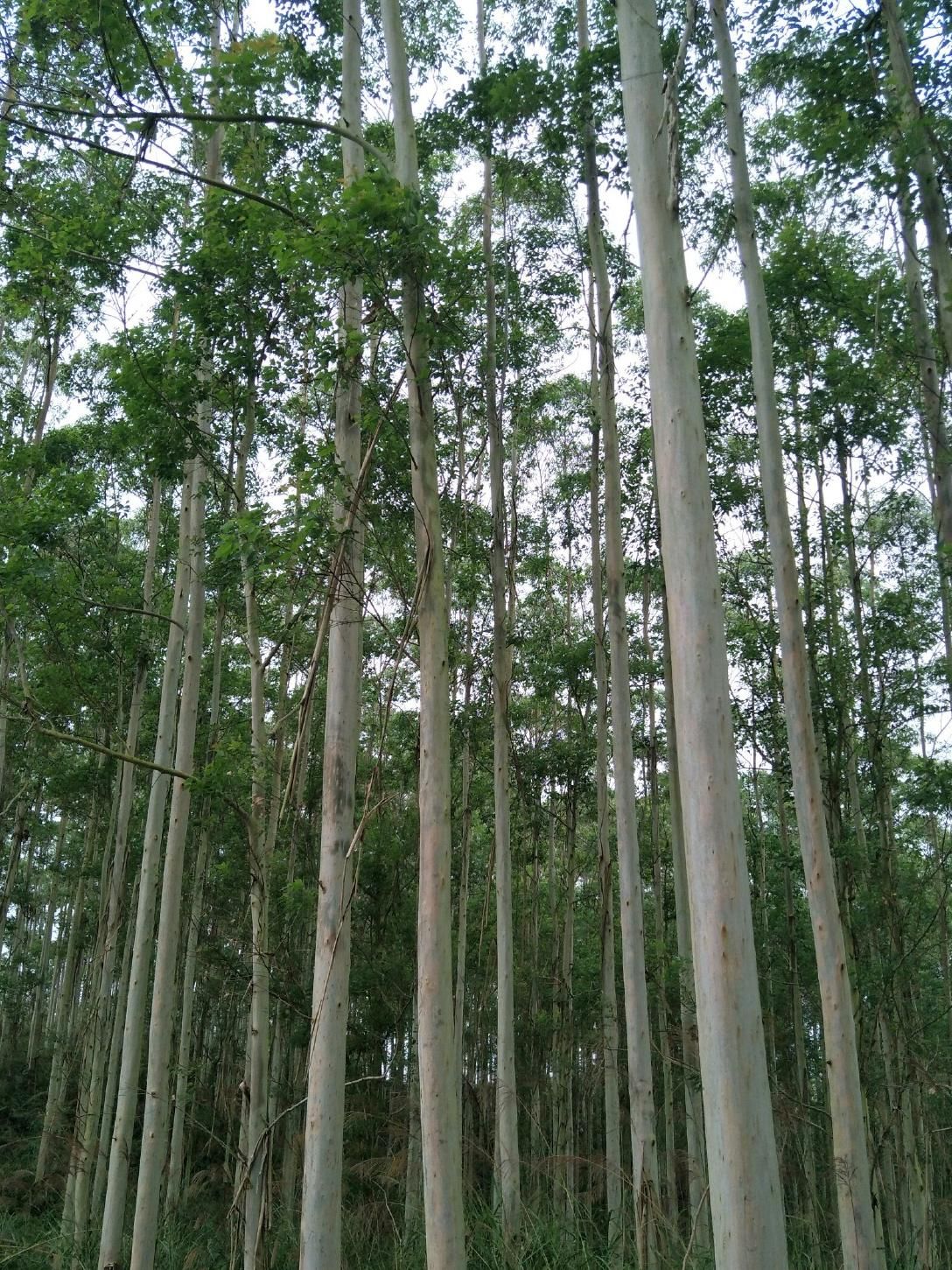
Eucalyptus (broadly including Eucalyptus, Corymbia, and Angophora in Myrtaceae) comprises 1,039 taxa (species, subspecies, varieties). Mostly evergreen trees, eucalypts are renowned for wide adaptability, strong stress tolerance, drought/poor-soil resistance, easy establishment, and vigorous coppicing. They range from tropics to temperate zones, from coasts to mountains, and from plains to highlands. Reproduction is primarily by seed (self-pollination possible).
In modern Chinese, the term “桉” derives from a historical transliteration with connotations of utility (timber for implements) and health (anti-miasma). With fast growth, straight stems, and broad end uses, eucalypts support pulp & paper, reconstituted panels, construction, biomass energy, and value-added products such as eucalyptus oil and eucalyptus polyphenols.
Origin & Spread
Origin
An ancient group tracing back to the late Cretaceous (~65 Ma), native to Australia, Papua New Guinea, Indonesia, and the Philippines. In 1770, botanists J. Banks and D. Solander collected classic eucalypt specimens (e.g., Corymbia spp., broad-leaf types) during Captain James Cook’s Australian voyage.
Global spread
Today, 120+ countries grow eucalypts; major plantation nations include India, Brazil, China, Uruguay, Portugal, South Africa, Spain, Chile, Thailand, etc.
Spread with China
First introductions date to 1890. In 1910, envoy Wu Zonglian compiled An Pu, China’s earliest monograph on eucalyptus. Plantings now span >600 counties across 20 provinces/autonomous regions, horizontally from 18°20′N (Sanya) to 33°00′N (Hanzhong) and vertically from coastal South China up to ~2,100 m (Lancang, Yunnan). 300+ taxa have been introduced for trials.
Applications & Value
Although not a human food crop, eucalyptus leaves contain nutrients relevant to forage formulations and industrial uses.
-
Macronutrients (young stands): N 15.56–26.56 g/kg, P 0.51–1.03 g/kg, K 6.04–13.17 g/kg (typical ranking K > Ca > Mg > P in the same organ).
-
Micronutrients: Cu 3.29–8.50 mg/kg, Zn 12.82–24.38 mg/kg, B 29.84–43.90 mg/kg; Mn often the highest among traces, Cu the lowest.
-
Fertilization guidance (regional): Most Guangxi sites show adequate foliar nutrients; Debao (P, K deficiency) and Tiandong (Cu deficiency) suggest appropriate P/K/Cu supplementation to sustain growth.
Economic & Cultural Value
-
National timber security. China hosts ~6.0 million ha of eucalyptus plantations (world #2). On ~2% of national forest area, annual eucalyptus wood output exceeds 30 million m³, contributing >30% of China’s timber.
-
Full value chain. A complete industry has formed—seedlings, fertilizers, sawmilling, pulp & paper, panels, biomass energy, and non-wood products. Guangxi’s eucalyptus chain exceeds RMB 500 billion annually, underpinning its trillion-yuan forestry economy.
-
Multiple uses. Logs for pulp/paper, panels, solid wood construction/furniture; dense wood/roots for charcoal; branches/bark residues to biomass pellets; leaves/tender shoots for eucalyptus oil and polyphenols.
-
Landscape & ecology. Tall, evergreen forms suit sanatoria, residential areas, hospitals, and parks. Strong carbon sequestration (~37.8 t CO₂/ha/yr reported), robust roots for soil stabilization, and dense canopies to filter air.
Eucalyptus Production in China at a Glance
-
Scale & Output
-
Plantation area: ~6.0 million ha (world #2).
-
Annual timber: >30 million m³ (≈ one-third of national timber).
-
Productivity: Wood production efficiency vs. common species—×1.78 (poplar), ×2.27 (Chinese fir), ×3.57 (Masson pine), ×5.88 (larch).
-
-
Key Regions
-
Concentrated in Guangxi, Guangdong, Fujian, Yunnan, Hainan and other warm southern provinces. Guangxi leads in area, output, and returns—with ~1% of national forest land contributing ~40% of China’s timber (2017 total 30.59 million m³, ≈ 45% of commercial timber; ¾ from eucalyptus).
-
-
Industry Traits & Challenges
Traits — Ecological silviculture systems (multi-species mixing, biodiversity conservation, self-fertility enhancement); full-chain integration (planting–processing–sales–R&D–agri-tourism); fast rotations (≈5–8 years).
Core Challenge: Plant Protection —-
Complex dynamics: Key targets (e.g., eucalyptus gall wasp, bacterial wilt, leaf scorch) correlate with weather, stand structure, and age, complicating forecasts.
-
Terrain & access: Hilly forests hinder ground rigs → delayed operations.
-
Labor & cost: Short labor supply and rising costs reduce timeliness and completeness.
-
Resistance pressure: Long-term single-chemistry use selects resistance in insects and pathogens.
-
Direct losses: Poor control suppresses growth and yield and degrades timber quality, cutting marketable rates and margins.
-
Major Pests & Diseases
Key Insect — Eucalyptus Gall Wasp
-
Damage: Attacks tender shoots/leaves; galls induce curling and malformation, stunting growth and causing decline or mortality when severe.
-
Control essentials: Plant tolerant varieties; strengthen quarantine (no infested seedlings in/out); prune & destroy infested shoots promptly; conserve natural enemies; treat early with labeled systemic insecticides.
Key Diseases
Leaf Scorch (blight complex)
-
Damage: Water-soaked specks on leaves progress to irregular brown patches; severe cases cause leaf scorch/abscission and dieback of tender shoots.
-
Control essentials: Winter sanitation; rational spacing for airflow & light; balanced fertilization to boost vigor; treat at onset with approved fungicides (e.g., DMI/QoI where labeled).
Bacterial Wilt
-
Damage: Root/collar infection → vascular browning, leaf desiccation/wilting, whole-tree death.
-
Control essentials: Use resistant stock; rotation; rogue and destroy infected trees; soil disinfection around foci; strengthen nursery quarantine; early antibacterial drenches per label.
Recommended Operation Parameters (Eucalyptus — Gall Wasp / Foliage Targets)
|
Target pest/disease |
Application rate |
Droplet size |
Flight height |
Flight speed |
Route spacing |
Gall Wasp |
5–10 L/mu (≈ 75–150 L/ha; ≈ 30–61 L/acre) |
≈ 60 μm |
≈ 4–5 m above canopy |
3–5 m/s |
≈ 4–5 m |
The parameters above are for reference only. Please adjust the operation settings to the actual crop growth stage, field conditions, and equipment model.
These parameters are derived from trials in major eucalyptus-growing regions. Pest and disease incidence varies by region and season—select and apply pesticides as required.
Why J150 for Eucalyptus — High-Throughput Forest Care, Deeper Canopy Penetration
Across Guangxi’s expansive plantations, the EAVISION J150 precision agriculture UAV meets the challenge of large-scale, time-critical protection. With high payload and long endurance, the J150 accelerates spray cycles and reduces operating cost per hectare. Its strong downwash drives droplets through dense, tall canopies for uniform, 3D deposition, enabling precise control of gall wasp, bacterial wilt, and leaf diseases. By pairing efficiency with coverage, the J150 supports healthy, fast growth and safeguards the sustainability of China’s green industry.