Droplet Size for Drone Spraying: Choosing 10-300 Microns for Different Crops


Drone spraying droplet size is one of the smallest settings on a spray job, but it has an outsized effect on coverage, canopy penetration, chemical loss, and drift risk. A few microns can change how many droplets reach the leaf, how long they stay airborne, and whether the application performs the way the product label expects.
There is no single "best" droplet size for every crop. A fungicide aimed at dense orchard foliage does not need the same spray quality as a systemic herbicide over an open field. A calm morning does not create the same drift risk as a warm, dry afternoon near sensitive crops. Even the same drone can need different settings as crop height, canopy density, flight speed, and application volume change.
This guide explains how to think about a 10-300 micron droplet range for agricultural drone spraying. It also shows how to match droplet size to crop type, target surface, weather, and equipment, with a practical calibration checklist for operators.
What Droplet Size Means
Droplet size is usually measured in microns. One micron is one millionth of a meter, so spray droplets are tiny even when they are considered "large" in application terms.
In spray science, operators often talk about droplet size as a distribution, not as one perfect number. A nozzle or atomizer does not produce identical droplets. It produces a spectrum of fine, medium, and larger droplets. That is why labels, nozzle charts, and technical documents often refer to spray quality categories such as fine, medium, coarse, very coarse, or ultra coarse.
Nebraska Extension explains that droplet size is a key factor in particle drift because smaller droplets slow down faster, remain airborne longer, and are easier for air movement to carry away from the target. It also notes that droplets below 100 microns are considered highly driftable.
For drone spraying, this matters because the aircraft is not only producing droplets. It is also producing rotor airflow. The interaction between droplet size, downward airflow, canopy shape, and wind decides where the spray actually lands.
Why Droplet Size Matters in Drone Spraying
Droplet size affects four practical outcomes: coverage, penetration, drift, and retention.
- Coverage describes how much of the target surface receives spray. Smaller droplets can increase droplet count at the same spray volume, which can improve surface coverage for some contact products. This is one reason fine-to-medium droplets are often discussed for fungicide and insecticide applications where the target surface matters.
- Penetration describes whether droplets reach the middle and lower canopy, not just the top leaves. In drone work, penetration depends on droplet size, flight height, speed, spray width, air volume, canopy density, and whether the rotor airflow can carry droplets into the crop structure.
- Drift is the off-target movement of spray droplets. EPA defines pesticide drift as pesticide droplets or dust moving through the air at or soon after application to a site other than the intended area. Smaller droplets are generally more drift-prone because they remain airborne longer.
- Retention describes whether droplets stick, spread, bounce, or run off after contact. NDSU Extension notes the tradeoff clearly: smaller droplets can improve coverage, but they are more susceptible to drift, while droplets that are too large may bounce or run off the target.
The operator's job is not to choose the smallest droplets possible. The job is to choose a droplet spectrum that gives enough target coverage while keeping drift, runoff, and off-target exposure within acceptable limits.
The 10-300 Micron Range: How to Think About It
A 10-300 micron range should be treated as an adjustable operating window, not as a universal prescription. In practical terms:
|
Droplet Range |
Practical Meaning |
Typical Use Case |
Main Caution |
|
10-50 microns |
Very fine mist behavior |
Specialized canopy penetration, controlled conditions, equipment-specific use |
High drift sensitivity if not managed by airflow, weather, height, and label rules |
|
50-100 microns |
Fine spray behavior |
Contact coverage where target capture is strong and drift risk is low |
Droplets below 100 microns are highly driftable in many conditions |
|
100-200 microns |
Fine-to-medium behavior |
Balanced coverage for many drone spraying tasks |
Must still match label, crop, wind, humidity, and application volume |
|
200-300 microns |
Medium-to-coarser behavior |
Drift reduction, more robust droplets, some systemic products |
Lower droplet count at the same volume can reduce coverage if water volume is too low |
These ranges are practical guideposts, not legal instructions. The pesticide label, local regulation, crop stage, adjuvant choice, weather, and drone calibration should always control the final decision.
How to Choose Droplet Size by Crop and Target
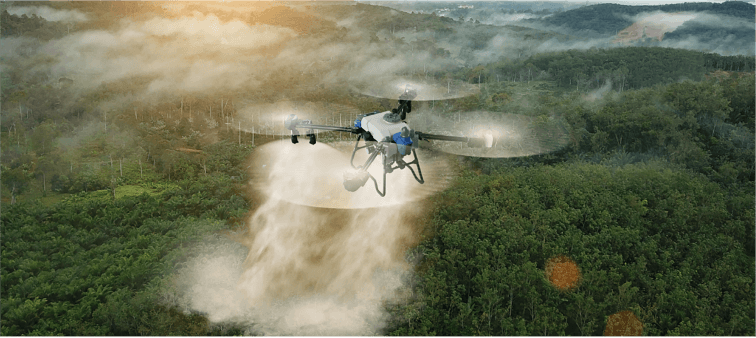
The right drone spraying droplet size starts with the target. Ask what the product needs to hit, then tune the spray system around that target.
Orchards, Vineyards, and Tall Canopies
Orchards, vineyards, tea fields, and other multi-layer canopies are difficult because the spray must reach more than a flat top surface. Leaves, branches, fruit clusters, and internal canopy layers can block droplets.
Ohio State University Extension notes that orchard and vineyard drift risk is often higher than field crop spraying because the target is less uniform, droplets may travel farther from the nozzle, and sprayer airflow can carry droplets in horizontal or upward directions. For drone spraying, rotor airflow changes the application pattern, but the same core challenge remains: dense canopies require careful droplet and airflow management.
In these crops, smaller droplets may help improve coverage on hidden surfaces when the equipment can carry them into the canopy. However, very fine droplets should be used only when wind, humidity, flight height, buffer zones, product label, and operator skill support that choice. A mixed droplet strategy can be useful: larger droplets help coat exposed leaf surfaces, while finer droplets can help reach underside or interior targets.
Row Crops and Open Field Crops
Open field crops often have a more uniform target than orchards, especially early in the season. The operator can usually prioritize label-required spray quality, drift control, swath consistency, and productivity.
For many herbicide and systemic applications, medium or coarser droplets may be preferred because the product does not require extreme surface coverage and drift control is a major concern. For contact fungicides, insecticides, or defoliants, the operator may need more surface coverage, which can mean adjusting droplet size, volume, speed, and route overlap together.
The key is to avoid treating droplet size as the only lever. If droplets are made larger to reduce drift, application volume may need to increase to preserve coverage. NDSU Extension explains that increasing droplet size sharply reduces droplet number at the same volume, so water volume and spray quality should be considered together.
Vegetables and Specialty Crops
Vegetables and specialty crops often need high coverage because leaf surfaces, underside areas, growing points, and tender tissue can all be relevant. At the same time, they may be sensitive to residue, burn, or off-target exposure.
For these crops, droplet size should be selected with the product label and crop sensitivity in mind. Fine-to-medium droplets may support better coverage when drift risk is low and canopy capture is good. Medium droplets may be safer when drift-sensitive crops, nearby homes, water bodies, or unfavorable weather increase the risk profile.
Herbicides Near Sensitive Areas
Herbicide spraying near neighboring crops, orchards, greenhouses, waterways, or residential areas deserves a conservative setup. Pesticide drift can damage nearby crops, create complaints, waste product, and reduce the dose on the intended target.
In these situations, operators should favor label-compliant drift-reduction practices: coarser droplet settings when allowed, lower practical flight height, correct route direction, buffer zones, appropriate wind conditions, and avoiding temperature inversions. If conditions are not favorable, delaying the job is often the most professional decision.
Fungicides and Insecticides Requiring Contact Coverage
Fungicides and insecticides often depend on coverage because pests and pathogens may be on leaf surfaces, undersides, fruit clusters, stems, or dense internal foliage. Smaller droplets can increase the number of impacts per unit volume, but they also increase drift risk.
A good strategy is to define the target first. If the target is mostly on exposed upper leaves, a medium setting may be enough. If the target is inside a dense canopy, operators may need a more coverage-oriented setting, slower speed, adjusted flight height, stronger route discipline, or a platform designed for canopy penetration.
Agricultural Drone Nozzle and Atomizer Choices
An agricultural drone nozzle or atomizer controls how liquid becomes droplets. This is where drone spraying differs from a simple "tank plus pump" view of application.
Hydraulic nozzles use pressure and an orifice to form the spray pattern. Rotary atomizer drone systems use a spinning disc, cage, or related atomizing component to control droplet formation. Other drone systems use proprietary atomization designs. In all cases, droplet size is affected by equipment design, liquid properties, flow rate, pressure or motor speed, nozzle wear, and flight parameters.
When choosing or comparing spray drones, operators should ask:
- What droplet range can the system produce?
- Can droplet size be adjusted from the controller or app?
- Does the system maintain stable droplet size as flow changes?
- How does the system perform at the required application volume?
- Does the nozzle design support the target crop, such as orchards, rice, cotton, vegetables, or vines?
- How easy is the agricultural drone nozzle to clean, inspect, and replace?
- What service life, spare parts, and calibration support are available?
The best nozzle is not simply the one that can make the finest mist. The best nozzle is the one that repeatedly produces the right droplet spectrum for the crop, product, weather, and job plan.
The EAVISION Approach: Mixed Droplets for Canopy Coverage
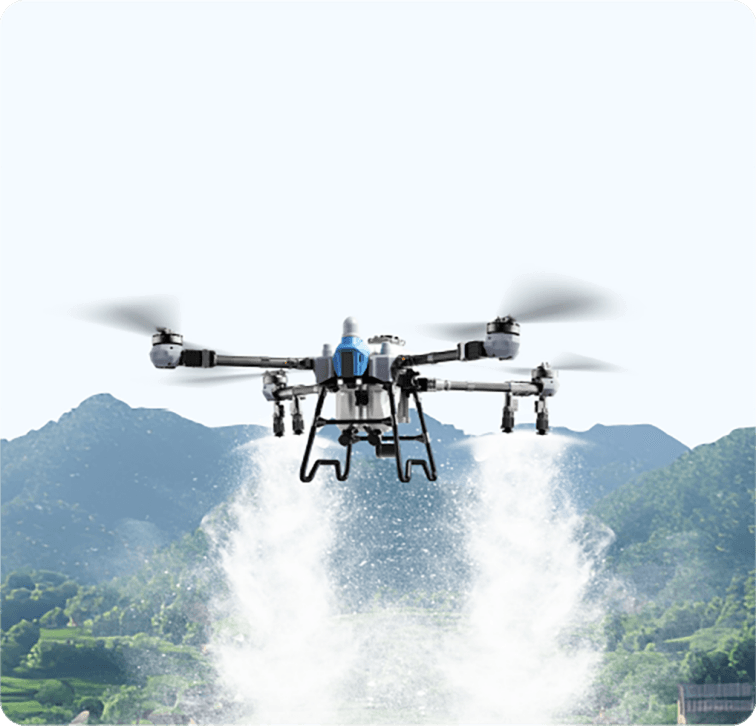
EAVISION's J150 is designed around canopy coverage rather than flat-field spraying alone. The EAVISION J150 product page lists a droplet size specification of 10-300 microns, a maximum flow rate of 40 L/min, a 70 L spray tank, and an effective spray width of up to 15 m.
The system uses a 4th-Gen CCMS Bimodal Mist Nozzle. EAVISION describes the nozzle system as supporting high-volume spraying and producing droplets under 40 microns even at a 40 L/min flow rate. The J150 page also describes Hybrid Droplet Technology, with four droplet sizes in a single flight and each nozzle adjustable between 10-300 microns.
That mixed-droplet concept is important for dense crops. Larger droplets can help coat leaf surfaces. Smaller droplets can move with airflow toward underside and internal canopy targets. Combined with downward vortex airflow, the spray field is designed to support multi-layer canopy coverage rather than only wetting the top of the crop.
EAVISION's spraying solution page makes the same point from a field performance angle: drone spraying performance depends on droplet control, airflow utilization, canopy penetration, and operational efficiency working together.
For operators, this means the J150 should be evaluated as a complete spray system. Droplet range, nozzle technology, route planning, rotor airflow, field mapping, flight speed, and after-sales training all affect the final result.
Weather and Drift: Conditions That Change the Right Setting
Even a well-calibrated drone can produce poor results in the wrong conditions. Droplet size decisions should always be adjusted for weather.
- Wind speed and direction are the most visible factors. More wind means more risk that droplets move away from the intended target. Wind direction also matters because the downwind side may contain sensitive crops, houses, roads, workers, water, or livestock.
- Temperature and humidity affect evaporation. Hot, dry conditions can shrink droplets, making them more drift-prone before they reach the crop. In those conditions, a droplet setting that worked well in cooler, more humid weather may become risky.
- Temperature inversions are especially dangerous. During inversion conditions, small droplets can remain suspended and move laterally instead of dispersing upward. Calm conditions near sunrise or after sunset can sometimes indicate inversion risk, so operators should use local guidance, field observations, and label rules rather than assuming "no wind" always means "safe."
- Flight height and speed are also part of drift management. Higher flight height gives droplets more time to move before reaching the crop. Faster speed can reduce deposition time and change the relationship between airflow, swath, and canopy capture.
Practical Decision Workflow
Use this workflow before selecting drone spraying droplet size:
1. Read the label first. Confirm required droplet category, application volume, buffer zones, restrictions, PPE, and weather limits.
2. Define the biological target. Decide whether the spray must reach top leaves, underside surfaces, fruit clusters, stems, weeds, soil, or internal canopy layers.
3. Inspect the canopy. Note crop height, row spacing, leaf density, growth stage, and whether the canopy is open or layered.
4. Check sensitive areas. Identify nearby crops, water, houses, roads, workers, pollinator areas, and livestock.
5. Measure weather at the field. Do not rely only on a regional app. Check wind, gusts, direction, temperature, humidity, and inversion risk.
6. Choose the starting droplet range. Use finer settings for coverage only when drift risk is controlled. Use medium or coarser settings when drift control is the priority and label allows.
7. Match volume to droplet size. If droplets become larger, make sure water volume and route overlap still provide enough coverage.
8. Calibrate drone settings. Match droplet size with flow rate, flight speed, spray width, height, route spacing, and tank mix.
9. Verify deposition. Use water-sensitive paper, test passes, crop scouting, or residue checks when appropriate.
10. Record the job. Save crop, product, droplet setting, weather, height, speed, volume, field map, and operator notes.
Conclusion
Drone spraying droplet size is a decision about balance. Fine droplets can help coverage and canopy reach, but they raise drift concerns. Larger droplets can reduce off-target movement, but they may reduce droplet count or coverage if volume and targeting are not adjusted.
For operators, the strongest approach is to start with the pesticide label, define the crop target, inspect the canopy, check weather, choose an appropriate droplet range, and verify deposition in the field. For distributors and farm managers evaluating equipment, the question should be broader than "how fine can it spray?" A better question is: can the system control droplet size, airflow, flow rate, route planning, and canopy penetration together?
That is where the EAVISION J150 fits the discussion. Its 10-300 micron range, 4th-Gen CCMS Bimodal Mist Nozzle, Hybrid Droplet Technology, and canopy-focused spraying solution are designed for operators who need more than simple top-surface wetting. They need the right droplet behavior for the right crop at the right time.
FAQ
What is the best drone spraying droplet size?
There is no single best droplet size. The right choice depends on the pesticide label, crop, target surface, canopy density, weather, drift risk, application volume, and drone nozzle design.
Are smaller droplets always better for coverage?
Smaller droplets can increase droplet count and improve coverage in some situations, but they are also more drift-prone. Use finer droplets only when the target and operating conditions justify the risk.
Can larger droplets reduce pesticide drift?
Larger droplets generally fall faster and are less drift-prone, but droplets that are too large can reduce coverage, bounce, or run off the leaf surface. The goal is balanced spray quality, not simply the largest droplet possible.
What droplet size range does the EAVISION J150 support?
The EAVISION J150 product page lists a 10-300 micron droplet size range. It also describes the 4th-Gen CCMS Bimodal Mist Nozzle and Hybrid Droplet Technology for mixed droplet spraying.
Is a rotary atomizer drone better than a pressure nozzle drone?
Not automatically. A rotary atomizer drone can offer precise droplet control when designed and calibrated well, while hydraulic or proprietary nozzle systems can also perform well. Compare the full spray system: droplet range, flow stability, maintenance, calibration support, crop fit, and service network.