Drone Spraying vs Ground Spraying: Which Is Better?


You have a field that needs spraying before the rain hits. The soil is still wet from last week. Your ground sprayer will leave ruts and tear up the crop if you send it in now. A drone could fly tomorrow morning and get the job done.
But walk to the other side of the farm and the picture changes. That big, flat block is ready for the ground rig. A drone would burn through batteries and refills just trying to keep up.
This is what the drone spraying vs ground spraying question actually looks like in the field. It is not about which machine wins on paper. It is about which one fits the field, the crop, the weather, and the job you need to finish today. Here is how to think it through.
Drone Spraying vs Ground Spraying Quick Answer
|
Decision point |
Spray drone |
Ground sprayer |
|
Best fit |
Wet, steep, fragmented, or hard-to-enter fields |
Large, flat, open fields with good trafficability |
|
Carrier volume |
Usually lower, with frequent refills |
Higher volumes supported by large tanks |
|
Field throughput |
Flexible, but limited by payload and battery cycles |
Usually faster for full-field broadcast work |
|
Crop and soil contact |
No wheel tracks or machine traffic |
Wheel traffic can damage crops or compact wet soil |
|
Spot treatment |
Easy to move between small or isolated zones |
Less efficient when only a small area needs treatment |
|
Weather sensitivity |
More exposed to wind and short flight windows |
Lower release height, but still limited by wind and wet ground |
Use the table as a starting point, not a final answer. A well-calibrated ground rig can outperform a poorly planned drone job. The reverse is also true when a large sprayer cannot enter the field at the right time.
Related article: Agricultural Drone vs. Traditional Sprayer: Which Is Better for Modern Farming?
How Drone and Ground Sprayers Work Differently
A ground sprayer carries a large tank and applies liquid through a wide boom. Its nozzles sit relatively close to the target. The machine can hold a steady speed and support the higher carrier volumes required by many labels and coverage-sensitive products.
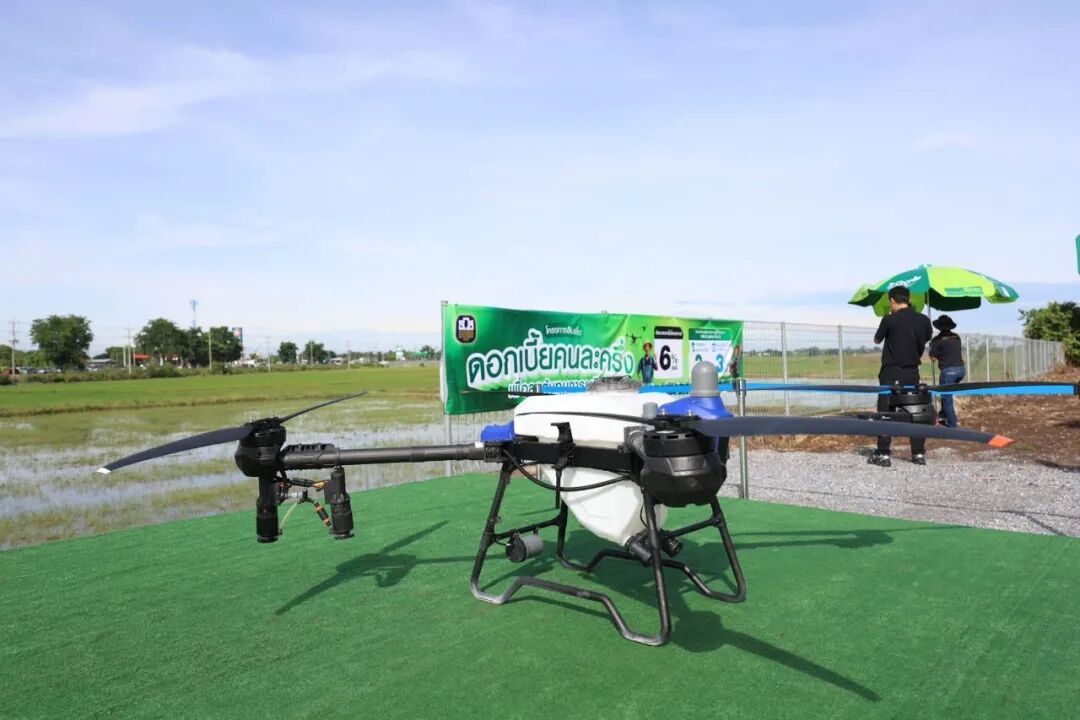
A spray drone carries much less liquid. It follows a planned flight path and uses rotor airflow to move droplets toward the crop. The operator adjusts flow, speed, height, droplet size, and effective swath. Those settings interact, so changing one may change coverage somewhere else.
The University of Minnesota Extension notes that drone trials have produced results similar to ground rigs while using about one-tenth of the carrier volume in the work discussed. That finding is useful, but it is not a shortcut. Low-volume spraying still needs label approval and field verification.
Which Method Covers More Acres
On a large, flat field, the ground sprayer usually wins on raw throughput. A wide boom and a large tank allow long runs with fewer stops. If the field is dry and the crop has enough clearance, a ground rig can finish broad-acre work efficiently.
Drone output is shaped by the whole cycle. Count filling, takeoff, spraying, landing, battery exchange, charging, cleaning, and movement between fields. A headline flight speed does not show how many acres the crew will actually finish.
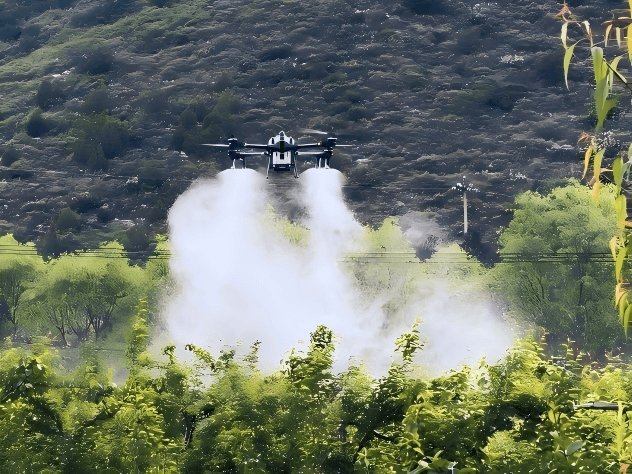
The balance changes when access becomes the bottleneck. A drone can launch beside a wet or divided field and start work without waiting for the soil to carry a heavy machine. It can also treat a small missed block without unfolding a boom or driving through the rest of the crop.
Which Gives Better Application Quality
Neither method guarantees better coverage by itself. Ground rigs benefit from stable boom geometry, closely spaced nozzles, and higher carrier volume. Those features can be valuable for contact products and dense targets that need thorough coverage.
Drones add another tool: downward rotor airflow. It may help move droplets into a canopy, but the result changes with crop structure, wind, height, speed, droplet size, and pass overlap. Crosswinds can also shift the effective swath.
Test both methods the same way. Use the same field, target, application rate, and suitable weather. Place water-sensitive cards across the center and edges of several passes. Then inspect deposition, misses, overlap, and canopy position. The useful swath is the width that gives acceptable coverage, not the largest number shown on a brochure.
How Field Conditions Change the Decision
Ground sprayers need a safe path through the field. Wet soil can delay entry and increase compaction risk. Penn State Extension advises staying off fields when soil is too wet and notes that much of the increase in soil density and wheel sinkage can happen on the first pass.
Drones avoid wheel traffic. That makes them useful for saturated ground, late-season corn, rice paddies, terraces, orchards, and irregular plots. They can also reach isolated patches near obstacles where a large boom would be awkward.
Ground equipment still has an advantage in open fields with predictable lanes. It is less dependent on repeated battery and refill stops, and the operator can carry more water when the label or crop target demands it.
Drone Spraying vs Ground Spraying Cost
Compare cost per completed acre, not the purchase price alone. A ground rig brings fuel, maintenance, depreciation, labor, tender support, and possible crop damage from wheel tracks. A drone needs batteries, chargers, a generator or power source, a mixing and refill system, transport, training, repairs, insurance, and regulatory work.
University of Missouri Extension modeled drone ownership at different annual workloads. Under its stated assumptions, higher use spread fixed costs across more acres, while low annual use made ownership harder to justify. That is why hiring a drone service can be a sensible first step.
The hidden cost is a missed spray window. If wet ground keeps a machine parked while disease or insects advance, a higher per-acre drone rate may still protect more value. On the other hand, paying a drone crew for a large, easy field may make little sense when an available ground rig can finish it faster.
Which Method Is Safer to Operate
A drone keeps the pilot away from moving booms, rough ground, and direct travel through the crop. It also removes the rollover and rutting risks that come with driving heavy equipment on slopes or wet soil.
It does not remove chemical exposure. The crew still mixes, loads, rinses, and handles residues. Propellers, batteries, obstacles, bystanders, and low-altitude flight add their own hazards. Ground sprayers also require careful filling, boom control, PPE, and cleanout.
For either method, the pesticide label decides what is allowed. The U.S. EPA notes that some labels contain specific aerial directions and some prohibit aerial application. Never assume that permission for ground application also covers a drone.
When Ground Spraying Is Better
- The field is large, flat, open, and dry enough for traffic.
- The job needs a high carrier volume or very thorough contact coverage.
- A wide boom can complete the work inside the spray window.
- The farm already owns a suitable rig and trained support equipment.
- Local rules or the product label do not allow drone application.
In these conditions, a ground sprayer is often the simplest and lowest-cost choice. There is little value in adding flight logistics to a job the existing machine handles well.
When Drone Spraying Is Better
- Wet soil, steep slopes, tall crops, or terraces block ground access.
- Only a small patch or field edge needs treatment.
- Wheel tracks could damage a high-value or late-season crop.
- Fields are fragmented, and a large boom is difficult to maneuver.
- The treatment window is open now, but the ground rig cannot enter.
For larger drone workloads, payload, flow, charging, and field support deserve a close look. The EAVISION J150 agricultural drone lists a 70 L spray tank, a maximum flow rate of 40 L/min, and an effective spray width of up to 15 m. Actual output will still depend on the labeled volume, route, crop, weather, and refill cycle.
Why a Hybrid Spray Plan Often Wins
A practical farm does not need to choose one machine for every acre. Use the ground rig for open, trafficable fields and high-volume work. Keep the drone for wet corners, late-season treatments, terraces, spot jobs, and blocks that would otherwise be delayed.
This split also gives the farm a backup plan. If rain closes the field to wheels, the drone may preserve the application window. If wind grounds the aircraft, the ground rig may still work where conditions and the label allow.
If you are weighing a drone for your own operation, the best next step is not a brochure. It is a field demo on your wettest corner, your steepest block, or the field your ground rig keeps missing. Talk to EAVISION or a local dealer about running a test pass with your crop, your product, and your conditions.
FAQ
Is drone spraying better than ground spraying?
Drone spraying is better for wet, steep, tall, fragmented, or small treatment areas. Ground spraying is usually better for high-throughput broadcast work on large, flat, accessible fields.
Can drones match ground sprayer coverage?
They can in some crops and applications, but the result depends on carrier volume, droplets, flight height, speed, swath, canopy, and weather. Verify coverage in the field and follow the product label.
Is drone spraying cheaper per acre?
Sometimes. Drone cost falls as annual use rises, but batteries, charging, transport, labor, and maintenance all matter. Hiring a service may cost less than ownership for occasional work.
Can a spray drone replace a ground rig?
Usually not for every job. Many farms get better value by using a ground rig for large open fields and a drone for inaccessible, time-sensitive, or targeted applications.