How Many Acres Can a Spray Drone Cover Per Hour or Per Day?


For most growers and spray service providers, the key question is not only how large the spray tank is. It is how many acres a drone can actually cover in a working hour or a full day.
The short answer: in open field crop conditions, a high-capacity agricultural drone can cover dozens of hectares per day when the operation is well organized. For example, EAVISION's spraying solution notes that the J150 can typically complete around 70-100 hectares per day in field crop conditions, which is about 170-250 acres per day. In orchards, where the drone must fly slower and focus on canopy penetration, daily coverage is usually much lower, often closer to 10 hectares or about 25 acres per day.
The practical answer depends on five variables:
- Flight speed
- Spray width
- Application volume
- Refill and battery cycle time
- Crop structure, terrain, and obstacle density
This guide explains how to estimate agricultural drone coverage rate before buying a drone, quoting a service job, or planning a full spray day.
Quick Formula: How to Calculate Spray Drone Coverage
Use this simple field-capacity formula:
Gross hectares per hour = flight speed (m/s) x spray width (m) x 0.36
Gross acres per hour = gross hectares per hour x 2.47
Adjusted acres per hour = gross acres per hour x field efficiency factor
The number you get first is the theoretical maximum while the drone is moving in a straight line and spraying. Real field capacity is lower because the drone must turn, refill, change batteries, avoid obstacles, pause for checks, and maintain safe spray quality.
For most planning, use a field efficiency factor:
- Open, rectangular field crops: 0.60-0.75
- Irregular fields or tall crops: 0.45-0.60
- Orchards and complex terrain: 0.25-0.45
That field efficiency factor is what turns a paper calculation into a more realistic daily plan.
Example 1: Open Field Spraying
On the EAVISION J150 product page, one rice-field spraying scenario lists:
- Application volume: 45 L/ha
- Operation speed: 6 m/s
- Spray width: 6 m
The gross field capacity is:
6 m/s x 6 m x 0.36 = 12.96 ha/hour
12.96 ha/hour x 2.47 = about 32 acres/hour
After field turns, refilling, battery rotation, route checks, and job setup, the adjusted hourly output may be much lower than the gross number. If the operation runs at 60-70% field efficiency, that example becomes roughly:
7.8-9.1 ha/hour
19-22 acres/hour
This is why a well-planned field operation can reach high daily coverage. The drone is not spraying every minute of the day, but automated routes, fast refilling, and battery rotation can keep downtime under control.
Example 2: Orchard Spraying
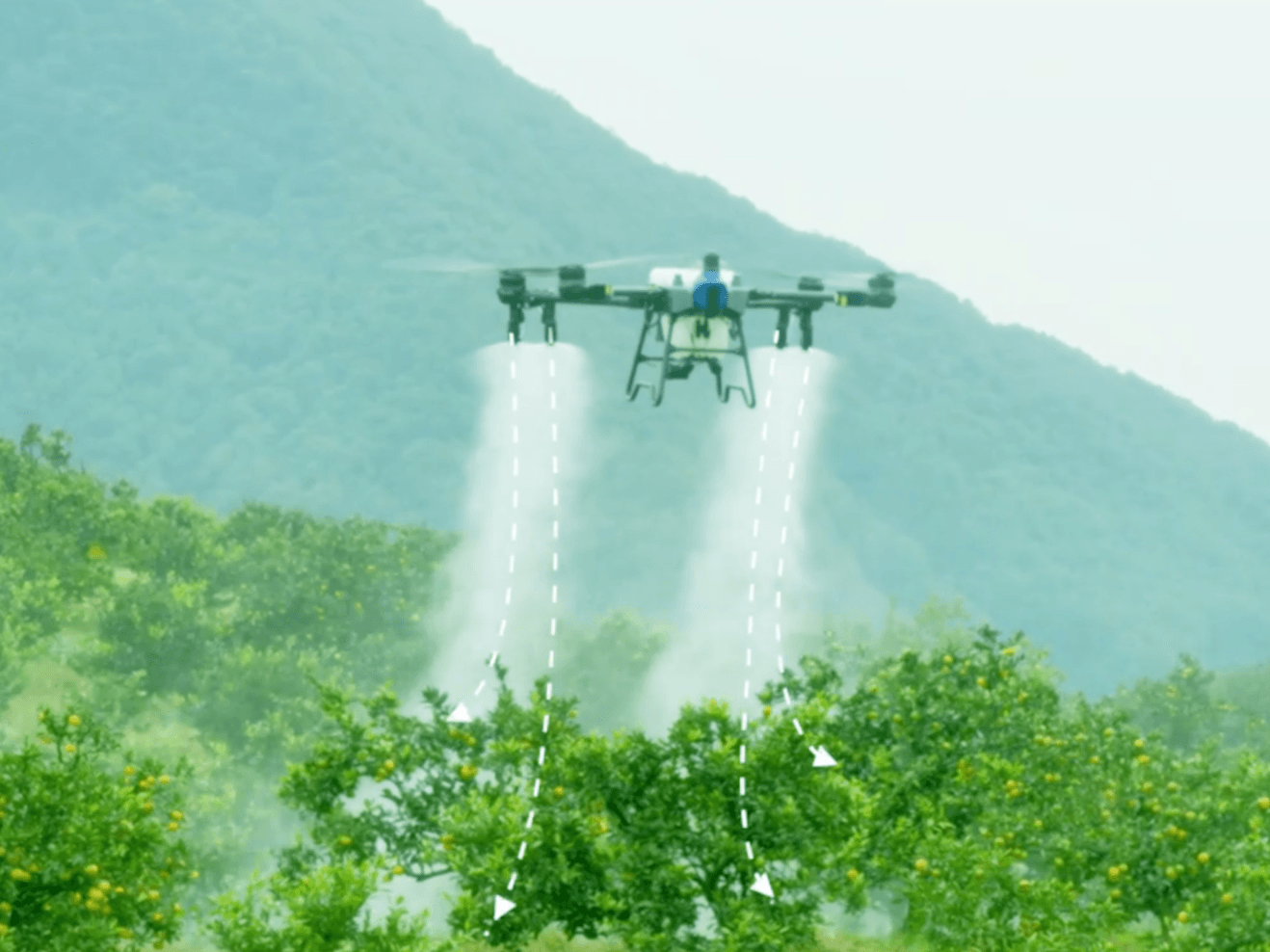
Orchards are different. Coverage quality matters more than raw speed because droplets need to reach the canopy, including inner and lower leaf areas.
For the J150 orchard spraying scenario, EAVISION lists:
- Application volume: 225 L/ha
- Operation speed: 2-3 m/s
- Spray width: 5 m
The gross field capacity is:
2 m/s x 5 m x 0.36 = 3.6 ha/hour
3 m/s x 5 m x 0.36 = 5.4 ha/hour
That is about 8.9-13.3 acres per hour before overhead.
In real orchard work, the adjusted number can drop sharply because the drone may need slower passes, more careful turning, tighter terrain following, and more frequent refill cycles due to higher application volume. That is why orchard daily coverage is often much lower than open-field daily coverage, even when using the same drone.
For fruit growers, that lower speed is not a weakness. It is often the price of better canopy coverage.
Do Tank Size and Flow Rate Limit Coverage?
Yes. Tank size, flow rate, and application volume all affect how long the drone can spray before refilling.
Use this tank coverage formula:
Hectares per tank = tank volume (L) / application volume (L/ha)
For a 70 L spray tank:
- At 45 L/ha, one tank covers about 1.56 ha, or 3.85 acres.
- At 225 L/ha, one tank covers about 0.31 ha, or 0.77 acres.
This is why low-volume field applications can cover more acres per day than high-volume orchard applications. The same drone, same tank, and same pilot can produce very different daily output depending on the crop and the required application volume.
Flow rate matters too. The required flow rate can be estimated as:
Required flow (L/min) = application volume (L/ha) x speed (m/s) x spray width (m) x 0.006
For the rice-field example:
45 x 6 x 6 x 0.006 = 9.72 L/min
That is comfortably below the J150's maximum flow rate of 40 L/min, leaving room for different crop settings and operating conditions. For orchard work, higher application volume may require more flow even at lower speed, so calibration becomes more important.
Why Spray Width Is Not Always the Same as Effective Coverage
A wider spray width can increase coverage rate, but only if spray quality remains acceptable.
Agricultural drone coverage is not the same as simply spreading mist as far as possible. The effective spray width must match:
- Crop height
- Canopy density
- Droplet size
- Rotor airflow
- Flight height
- Wind conditions
- Chemical label requirements
For large open fields, a wider effective spray width can improve productivity. For orchards, tall crops, or dense canopy structures, a narrower width and slower flight may be better because the goal is to place droplets where pests or diseases are actually present.
This is why a coverage-rate article should never rely on spray width alone. The best operating width is the one that balances speed, coverage uniformity, and drift control.
What Affects Spray Drone Acres Per Day?
1. Application Volume
Application volume has the biggest impact on daily output. A low-volume field operation at 45 L/ha can cover far more ground per tank than a high-volume orchard operation at 225 L/ha.
Before estimating acres per day, decide the agronomic target first. Coverage rate should follow the spray requirement, not the other way around.
2. Flight Speed
Faster flight increases theoretical capacity, but only until spray quality begins to suffer. In open, uniform fields, higher speeds may be practical. In orchards or uneven terrain, slower flight often improves penetration and consistency.
3. Spray Width
Spray width is a direct input in the coverage formula. However, usable spray width depends on droplet behavior, rotor downwash, canopy structure, and overlap strategy.
4. Refill Setup
A fast refill station can add more acres per day than a slightly faster flight speed. The most efficient teams prepare water, chemical mix, measuring tools, batteries, and landing zones before the drone returns.
5. Battery Rotation
Battery downtime can reduce real coverage rate if charging is not planned. The EAVISION J150 supports fast charging and two-battery cycling, which helps operators keep the drone working through longer spray windows.
6. Field Shape and Turning Time
Long, rectangular fields are efficient. Small, irregular plots create more turning, boundary checks, and route adjustments. Multi-plot operations also require more planning time.
7. Terrain and Obstacles
Power lines, trees, slopes, irrigation equipment, roads, and uneven terrain all affect productive spray time. Obstacle avoidance, mapping, route planning, and reliable communication can protect both safety and efficiency.
8. Weather Window
Wind, temperature, humidity, and rain risk can shorten the usable spray day. A drone may be capable of covering more acres than the weather allows.
Sample Planning Table
|
Scenario |
Speed |
Spray Width |
Gross ha/hour |
Gross acres/hour |
Practical Note |
|
Open field, moderate speed |
6 m/s |
6 m |
12.96 |
32.0 |
Adjust for refill, turns, battery rotation, and field shape. |
|
Orchard, slower canopy work |
2-3 m/s |
5 m |
3.6-5.4 |
8.9-13.3 |
Daily output is much lower because coverage quality and refill cycles dominate. |
|
High-speed vegetable foliar setup |
13 m/s |
7 m |
32.76 |
80.9 |
This is a gross ceiling; tank refills and spray quality determine real output. |
Use this table as a planning reference, not a guaranteed field result. The same machine can produce different outcomes depending on application volume, crew setup, field layout, and target coverage.
J150, J70, or J100: Which Drone Fits Your Coverage Goal?
If the goal is high daily coverage in large field operations, the EAVISION J150 is the flagship choice. It combines a 70 L spray tank, 40 L/min maximum flow rate, up to 15 m effective spray width, fast charging, and automated route planning.
If the goal is flexible solo operation, smaller farms, or mixed tasks, the EAVISION J70 is positioned for efficient one-person workflows. Its product page lists a 35 L spray tank, 24 L/min maximum flow rate, up to 10 m spray width, and an operational efficiency claim of up to 24 ha/hour under suitable conditions.
For users who want a balanced platform with spraying, spreading, lifting, and mapping, the EAVISION J100 is another option. Its product page lists a 45 L standard tank, optional 60 L tank, 24 L/min maximum flow rate, and operational efficiency up to 24 ha/hour in suitable field conditions.
The right choice is not simply the drone with the largest tank. It is the drone that best matches your crop, terrain, application volume, support needs, and daily work plan.
Related article: Crop Spraying Drones: How to Pick the Right One for Your Farm
How to Estimate Your Own Spray Day
Use this five-step worksheet before quoting a job or planning a spray window:
1. Choose the target application volume in L/ha or gallons per acre.
2. Choose a realistic flight speed for the crop and terrain.
3. Choose an effective spray width based on coverage quality, not only machine maximum.
4. Calculate gross capacity with the formula: speed x width x 0.36.
5. Apply a field efficiency factor based on refill time, battery rotation, turns, terrain, and obstacles.
Example:
Speed: 6 m/s
Spray width: 6 m
Gross capacity: 12.96 ha/hour
Field efficiency: 65%
Adjusted capacity: 8.4 ha/hour
Adjusted acres/hour: 20.8 acres/hour
Productive spray time: 8 hours
Estimated daily output: 166 acres/day
If your operation has faster refilling, strong battery rotation, and simple field shapes, output may be higher. If the field is fragmented, hilly, obstructed, or requires higher application volume, output may be lower.
Bottom Line
An agricultural drone's coverage rate is not one fixed number. It is the result of speed, spray width, application volume, refill time, battery rotation, terrain, and coverage target.
As a rule of thumb:
- Open field work can produce high daily coverage when routes, refills, and batteries are well organized.
- Orchard work is slower because canopy penetration and accurate placement matter more than raw speed.
- Tank size matters, but application volume and downtime often matter more.
- The best way to estimate acres per day is to calculate gross capacity first, then adjust for real field efficiency.
For growers and spray service providers, this approach makes planning more realistic. It also makes drone selection easier: instead of asking only "How big is the tank?", ask "How many acres can this drone cover with the spray quality my crop actually needs?"
FAQs
How many acres can a spray drone cover per hour?
It depends on speed, spray width, application volume, and downtime. A simple gross estimate is speed in m/s x spray width in meters x 0.36, then multiply hectares by 2.47 to get acres. Real output should be reduced for refilling, battery changes, turns, terrain, and safety checks.
How many acres can an agricultural drone spray in a day?
In open field crop conditions, a high-capacity drone can cover dozens or even hundreds of acres per day with a well-organized team. EAVISION's spraying solution gives the J150 as an example at around 70-100 hectares per day in typical field crop conditions, equal to about 170-250 acres per day. Orchard operations are usually much lower because they require slower, higher-volume spraying.
Why are orchard spraying rates lower than field spraying rates?
Orchards have dense canopies, tree rows, obstacles, and higher application-volume requirements. The drone often needs to fly slower and focus on penetration rather than speed. That improves coverage quality but reduces acres per hour.
Does a larger spray tank always mean more acres per day?
Not always. A larger tank can reduce refill frequency, but acres per day also depend on flow rate, battery cycle, field shape, refill setup, spray width, and required application volume. A well-organized refill and charging workflow can be just as important as tank size.
How can operators improve drone spraying efficiency?
Prepare water and chemical mix before the drone lands, plan safe takeoff and refill zones, use accurate field maps, choose realistic spray widths, rotate batteries efficiently, and avoid flying faster than the crop coverage target allows.
Is the spray drone coverage rate the same for all crops?
No. Rice, wheat, corn, vegetables, orchards, cotton, tea, and other crops can require different speeds, spray widths, application volumes, and droplet settings. Coverage rate should always be estimated by crop and field conditions.