Overview
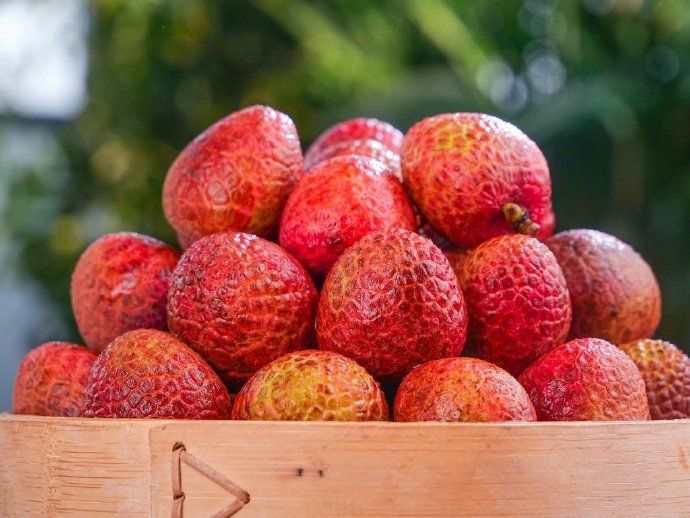
Lychee (Litchi chinensis) is an evergreen tree in the Sapindaceae family and a signature tropical–subtropical fruit of China—often hailed as the “king of fruit.” Trees commonly reach 10–30 m, with dense crowns and pinnate leaves. Fruits are heart- or round-shaped with a warty peel that ripens bright red; the translucent aril is juicy, sweet, and rich in vitamins and minerals.
Origin & Spread
Origin
Native to China, with documented cultivation and consumption for over two millennia. References date back at least to the Qin–Han era (e.g., accounts compiled in the Eastern Jin quoting offerings of lychee to the Han court).
Global Spread
Later introduced to Myanmar, India, Hawaii, and today is grown across parts of Central/South America, Africa, and Asia. In 1903, the “Songjiaxiang” variety from Putian was transplanted to Florida, then spread to the U.S. South and to Brazil and Cuba.
Spread with China. The Northern Song produced the world’s earliest lychee monographs (e.g., Cai Xiang’s Lizhipu), praising Fujian and Lingnan lychees as premier.
Nutritional Benefits
-
High vitamin C: 40–50 mg per 100 g—about half the daily recommendation; supports antioxidant defense, immunity, detox functions, and iron absorption.
-
Dietary fiber: Promotes GI motility.
-
Polyphenols: Procyanidins, quercetin and other phenolics provide antioxidant/anti-inflammatory activity.
-
Minerals & energy: Sugars (fructose, glucose, sucrose) deliver rapid energy alongside diverse minerals.
Consumption note. Lychee is sweet and sugar-dense; excessive intake may raise risks for weight gain and hyperglycemia—people with diabetes should be cautious (commonly advised ≤200 g/day, ~10 fruits). Large fasted intakes may trigger “lychee illness”–like hypoglycemic symptoms.
Economic & Cultural Value
Economic Value
-
Industry scale: China accounts for ~70% of global lychee supply; national primary output exceeds RMB 30 billion, and >50% of China’s production comes from Guangdong.
-
Full-chain development: Lychee drives rural tourism, F&B, cold chain, trade, and e-commerce. Deep-processed products include dried lychee, honey, wine, and drinks.
-
Cold-chain logistics: Dedicated air freight (e.g., SF Express) moved ~120,000 tons in 2023—China’s single-item leader in fresh cold chain.
Cultural Value
-
Cultural icon: From Du Mu’s “A single gallop raises the dust; the consort smiles—none know it’s lychee arriving” to Su Shi’s “Three hundred lychees a day; I’d gladly live long in Lingnan,” lychee is an enduring literary motif; imperial systems once maintained the famed “Lychee Route.”
Lychee Production in China at a Glance
-
Area & Output (2025 est.)
-
Area: ~7.517 million mu
-
Output: ~3.6504 million tons (+111% vs. 2024)
-
Key Regions
Region
Area / Output
Main Cultivars
Notes
Guangdong
4.199 million mu / 2.0626 Mt
Feizixiao, Guiwei, Nuomici
Maoming alone supplies ~1 in 5 lychees worldwide
Guangxi
2.3768 million mu / 1.1451 Mt
Heiye, Huaizhi, Jizuili
China’s largest late-maturing belt
Hainan
0.352 million mu / 0.184 Mt
Feizixiao, Ziniangxi, Baitangying
Early belt—starts late March
Fujian
— / 0.1326 Mt
Chenzi, Songjiaxiang, Zhuangyuanhong
Putian culture flourished Tang–Song
Sichuan
0.2505 million mu / 0.0488 Mt
Dahongpao, Dailü, Feizixiao
Very late belt (mid-Jul to early-Aug)
-
Industry Traits & Challenges
Tech enablement. 49 ministerial demo orchards (>20,000 mu); “five-modernization” smart orchards scale out UAV crop protection, IoT soil–moisture, and smart fertigation.
Diverse cultivars & staggered maturity. ~200+ cultivars; staggered layout supplies Mar–Aug, with Guangxi offering China’s longest season.
Core challenge — Pest & disease control
-
Weather-driven epidemics: Litchi fruit-pedicle borer and downy blight correlate strongly with rain/humidity; borer pressure is heavy in eastern Guangdong, the Pearl River Delta, and Hainan; downy blight surges in PRD/eastern Guangdong during rainy spells.
-
Operational limits: Large, tall canopies and hilly terrain make manual/ground spraying inefficient, with timing often missed; labor is costly and scarce; inadequate control cuts yield and marketable-fruit ratio.
Major Diseases & Pests
Key Diseases
Litchi downy blight
-
Damage: One of the most destructive lychee diseases—primarily attacks near-mature/mature fruit, also leaves; peaks from fruit enlargement to maturity.
-
Epidemiology: Prolonged overcast/rain during bloom and fruit development + high humidity → outbreaks.
-
Control essentials:
-
Cultural: Winter sanitation; pruning to improve airflow/light.
-
Chemistry: Treat promptly at first sign; rotate effective products per label (e.g., 25% amisulbrom SC 1,000–2,000×; 18.7% oxathiapiprolin + benzovindiflupyr WDG 800–1,000×).
-
Anthracnose
-
Damage: Common on leaves, panicles, fruit; worst near maturity, especially with hot, rainy preharvest weather.
-
Control essentials: Strong vigor via nutrition and canopy management; remove diseased tissues; protect during flowering/young fruit with labeled fungicides (e.g., 60% trifloxystrobin + mancozeb WDG 1,000–1,500×).
Key Insects
Litchi fruit-pedicle borer
-
Damage: Larvae bore fruit stalks, seeds, and tender shoots → fruit drop, wormy fruit, shoot loss; overall moderate-to-heavy pressure.
-
Control strategy:
-
Cultural: Collect/drop fruit during physiological drop to reduce sources.
-
Timed sprays: Track adult emergence, oviposition, and hatch peaks; spray at each peak, with thorough coverage of inner canopy and crown (e.g., 20% cypermethrin EC 2,000×, 10% acetamiprid EC 1,000–1,500×, per local labels).
-
Litchi stink bug (Tessaratoma spp.)
-
Damage: Adults/nymphs suck sap from tender flush, panicles, and young fruit → flower/fruit drop; moderate pressure in the PRD.
-
Control essentials: Early biological measures (e.g., parasitoid releases such as Anastatus spp. where available); labeled chemical options (e.g., phoxim 80% SP ~700×, lambda-cyhalothrin 25 g/L EC 2,000–4,000×) as per local guidance.
Recommended Operation Parameters
|
Target pest/disease |
Application rate |
Droplet size |
Flight height |
Flight speed |
Route spacing |
Litchi stink bug |
6–12 L/mu (≈ 90–180 L/ha; ≈ 36–73 L/acre) |
≈ 60 μm |
≈ 3–5 m above canopy |
3.0–4.5 m/s |
≈ 4–5 m |
The parameters above are for reference only. Please adjust the operation settings to the actual crop growth stage, field conditions, and equipment model.
These parameters are derived from trials in major lychee-growing regions. Pest and disease incidence varies by region and season—select and apply pesticides as required.
Why J100 for Lychee — Penetration, Timing, and Quality
In Guangdong’s core lychee belt, the EAVISION J100 agriculture uav delivers the coverage and timing growers need. Powerful rotor downwash and a precision spray system drive droplets to the crown tops and inner canopy, enabling effective control of fruit-pedicle borer, stink bug, and leaf/fruit diseases. Smart flight paths markedly boost efficiency in complex hilly orchards, helping reduce fruit drop and wormy fruit, lower costs, and protect the value of every Lingnan lychee.